Friday, 30 December 2022

A Prisoner of Fan Fiction

Writer Mike Bodnar has published his first novel, Unity, knowing that no matter how popular it becomes he will not make a penny from it...


I've recently finished writing my first novel. Thank you; a hat will be passed round shortly.

Image of Patrick McGoohan courtesy of Cultbox
However, to be clear, I had a springboard to leap from, and I can't lay claim to the original idea on which Unity is based. That, dear reader, is all down to one Patrick McGoohan (see pic), and if the name rings a bell it's because in the 1960s he was famous for playing agent John Drake in the British TV series Danger Man (Secret Agent in the United States), and, in 1967-68, as the unnamed eponymous lead in The Prisoner. It's this latter enigmatic series from which my novel takes its inspiration.

Why? Because The Prisoner has, for the past 55 years, confused, bewildered and beguiled audiences around the world, and still to this day people ask, what was it all about? What happened in the end? Did he ever really escape? And, just generally, WTF?

Prisoner fans re-enact the human chess game
from the episode 'Checkmate' during a convention.
(Image courtesy Welsh Holiday News)
There are multiple fan clubs and associations devoted to scrutinising The Prisoner's story arc(s) and quirks in minute detail. If you add up the memberships of those groups on Facebook alone you'll find almost 30,000 devotees. And there are multiple websites which attract membership from around the globe. There are even cosplay-style annual conventions. In short, The Prisoner very quickly acquired cult status, and shows little sign of slowing down.

As a result, there are many, many books that have been written about The Prisoner, some factual, others speculative, along with many novels and novellas. The - excuse the pun - captive audience laps them up, so I knew before starting out on my writing venture that there was a market out there hungry for more. I hope so; I'm banking on it.

Initial trial print run
Or rather, I'm not banking on it. Because I can't. I cannot - in fact am not allowed to - profit
from this work because I do not own the rights to the original work itself, the TV series. That is now held by television company ITV. And before you ask, yes I have tried to buy the rights, but have met with a blank refusal, along with a warning to 'seek independent legal advice.' But I will not be pushed, stamped, filed, indexed, briefed, debriefed or numbered, to quote The Prisoner himself, and am determined to see the drooling audience satiated. I am resigned to not making any money from it though.

So why bother? I hear you ask. Because, although not a rabid fan or cult follower, I have been intrigued by The Prisoner since first being enthralled by it as a 13-year-old, and have enjoyed watching the odd re-run over the years since. I have also now had over fifty years to ponder what McGoohan was trying to say with the series, and - thanks to the Prisonerverse - I've been able to view numerous documentaries, interviews and other random material, all of which have also tried to answer the same questions. There is no shortage of analysis, and I thank all those who have done all that research for me.

Portmeirion, the charming yet menacing 'village'
where The Prisoner was held captive
(Image: Mike Bodnar)


But that doesn't answer your question. For a long time I've had oblique thoughts about the obverse side of The Prisoner's story. If he'd resigned and was then captured and interrogated as to why, then what was it that made him resign? Why did he need to be caught and incarcerated? What threat was he? And who held him prisoner?

With those thoughts tumbling around in my head for a few years it was no surprise to me when they finally coalesced into a plausible storyline, told from the side of his captors. This - unlike so many of the other tie-in stories - doesn't aim to continue the story after The Prisoner TV series ends; mine is instead a contemporaneous narrative, paralleling what happens in The Prisoner from episode one to the final bewildering act. Although, if I were to base my story on all seventeen episodes it would be pushing 200,000 words and likely be a trilogy, and given that there's no financial reward to be had I was not about to embark on such an epic adventure. 

Be seeing you

Instead I have taken what many regard as the seven 'essential' episodes of the series and 
written a 1967-based spy thriller that sits alongside those stories and, hopefully, makes sense of them, or at least provides a viable explanation as to WTAF is going on. It is a more palatable 80,000 words, or just over 300 pages in paperback form. As stated in my foreword, the book aims purely to entertain, not to swell any coffers, and if there is inadvertent profit it will go to the Royal National Lifeboat Institution, the RNLI.

I self-published the book as, to be honest, I couldn't be arsed sending it to publishers or agents who these days don't bother reading anything and don't respond anyway. Also, as a tie-in novel they're unlikely to be interested. So the sale price of Unity will be to cover production/publishing costs.

I'm officially launching the book during the 2023 Prisoner convention (21-23 April). Called Portmeiricon, it's being held at 'The Village' itself in North Wales, and the organisers have very kindly given me an hour's slot in Hercules Hall at 7pm on the Saturday (22nd) for the launch. Copies of Unity will be available. I'll even sign one for you!

(However, would you like to be one of the first to read it? You can get Unity on Amazon right now!)

But where, then, do I get my reward? Well, I have thoroughly enjoyed writing Unity over the past two years, and that in itself is profit of sorts. If readers actually like it then that also is a bonus, as any favourable reviews will be. But there's more; while I openly admit to having used the basic storyline of The Prisoner as my muse, I have in the process created a raft of original characters within the zeitgeist of 1967 London and the British intelligence community.

The author pretending to work
I've grown to like these characters, and as I wrote the last few pages of the book it dawned on me that I could craft a sequel, only this time using my own dramatis personae, and a story not related to the TV series; in fact having no reference to The Prisoner at all. This makes the next book a stand-alone intellectual property of mine, and one which, fingers crossed, I can make as much money from as people will throw at me. Form an orderly queue.

All I can tell you at this stage is that it's set in Britain and the island of Ireland in 1970, and is called (working title) The Liscannor Intercept. Yes it's another spy thriller, and yes I have started writing it. But obviously, it's classified, and if I told you more I'd have to shoot you.

Update, at 25 October, 2025: 

The new cover on the second edition
Here I am almost three years on from when I first published this blog, and I have recently released the second edition of Unity. Content-wise there's not much that's changed; I dropped links and references to the book's website which, alas, no longer exists as it became prohibitively expensive to renew the site. I also dropped the crowdfunding link because, well, nobody was funding me, so that didn't work. Never mind.

Reviews for Unity on both Amazon and Goodreads have been fantastic (including, importantly, from Prisoner fans), and it gets a five star rating on both sites, so if nothing else that tells me not to mess with it too much!

The biggest change for the second edition is a new - and I think more dramatic - cover, and I present it here for your consideration. The book remains available in three formats: paperback, hardcover, (in the UK) and as a Kindle eBook. Sales haven't been great, and I'm still waiting for a film deal. I have, however, dropped the Kindle price to a very reasonable 99p (in UK money), so now is your chance to check out Unity. Thank you.

Thursday, 12 May 2022

Following the Arrows

 Mike Bodnar adds another string to his bow and spends a day with some Surrey archers…


Katniss Everdeen on target in The Hunger Games.
Image: fencing.net
Archery is something most of us know about only from films and television. John Rambo,
Katniss Everdeen, William Tell or Robin Hood, they’ve all pulled a bowstring for our entertainment, and maybe to save the world while they were at it – or in the case of the elf Legolas, Middle Earth.

As a result we know only that arrows are deadly, are shot from a bow or crossbow, and either find their target accurately or rain terrifyingly down in their hundreds from the skies above. 

From these brief but exciting small- and big-screen encounters we are therefore aware of the basic principles of the bow and arrow, but there are aspects of filmic archery that are nearly always wrong, as I learned from spending a day with some members of Surrey’s Longbow Heritage archery club recently.

Gerry May (aka 'Lord Raven'). Image: Mike Bodnar
‘The one thing they always get wrong in films,’ says veteran archer Gerry May with a chuckle, ‘is that they [the characters] always walk around with a strung bow,’ which, he says, would never have happened. 

The bows, he explains, were only as good as their strength when bent, so real archers would always carry them unstrung.

‘They’d string their bows when they were ready to shoot, but not before,’ he explains. 'Whereas if you keep it strung it will stay bent, and then you lose power.’

And that’s another thing he tells me: arrows are always shot. ‘You fire a gun but shoot an arrow.’ I have a lot to learn, but I am building up my archery knowledge in perhaps the most pleasant way possible – by strolling through some gorgeous deep-Surrey woodland on a perfect late spring day with the sun shafting through the trees lighting up the bluebells, and occasionally spotlighting an animal target. 

A rubbery fox. Image: Mike Bodnar
Because what Gerry and I are doing – along with novice archer Steve James who’s joined us to get some tips – is following a laid-out trail of eighteen targets ranging from hares and foxes through to a lynx, a bear and even a dragon. There are about twenty club members taking part today in this ‘friendly’ as it’s called. 

It’s not so jolly for the targets however. Known as 3-D field archery targets, most of them are quite convincing (although I can’t vouch for the dragon) but are actually made of a durable rubbery compound.

Each target point is identified by a number staked in the ground, so in a way it’s rather like playing a round of golf except that you’re permanently in the rough. And, unlike golfing greens which are usually out in the open, these targets have been cunningly placed deep in the wood and, occasionally, even behind foliage. But even though they can be almost hidden, finding the next target point is quite easy since the trail is marked – appropriately – with arrows.

Not just for Merry Men; Jurga Artse shows her skills.
About one in three archers is female.
Image: Mike Bodnar
It’s not just a matter of hitting your target once you’ve found it though. Each animal has a rough bull’s-eye carved into it - called the 'kill' - so you get points according to where your arrows hit. Miss and you get nothing. (And in case you do miss there’s a ‘backstop’ behind each animal – a big black square of substance that is there to stop your arrows disappearing into the forest).

As we approach the first target point Gerry tells me how the scoring works. ‘You get to shoot three arrows per target. In the ground, at different distances from the target there are pegs: a red one, white one and a blue one. The red is always furthest from the target, the white a bit closer, and the blue closest of all.’

Which means that if all your arrows hit home while your foot is against the red peg you can score maximum points, but the scoring decreases the closer you get to the target. If your first arrow misses then you must move to the white peg, and again if you don’t find the target you move to the blue peg. 

Gerry gives novice Steve some tips.
Image: Mike Bodnar
There’s also the matter of health and safety. Obviously a bow can be a deadly weapon, so it’s vital not to load your arrow before you’re ready to shoot.

‘It’s called “nocking,”’ Gerry says. ‘When you put the notch onto the bow string your arrow is nocked.’ He reminds Steve not to do this before placing his foot against the peg. 

The fact that an arrow could seriously injure or even kill someone is the reason I’m not having a go myself; the club rules simply don’t allow it. Even a novice archer has to first be signed-off by a club senior that they can shoot straight before being allowed to compete, hence I am purely an observer for the day. 

As we meander through the wood – Gerry and his Merry Men – I realise that there’s quite a science to designing a course like this. For one thing- as later confirmed by club secretary Carol Pearce who laid out the course – when shooting at a target you shouldn’t be facing any other target point or the trail, so that should an arrow somehow ‘go bush’ there is little chance of it finding a human target. 

Also, the 70-member club uses the wood by private arrangement with a local landowner; it‘s not open to the public or ramblers, so the chances of strangers wandering into the kill zone are minimal. 

The Longbow Heritage club house. Image: Mike Bodnar
As mentioned, not all the targets are in full view, and more than once Gerry and Steve have to shoot over or even through small trees or foliage. Some of the targets live: those where the arrows don’t find their mark. Gerry admits he’s not having a particularly good day, although when the arrows do find their target there’s a very satisfying and solid ‘thunk’ as they hit.

Disgruntled with his score (Steve was happier with his), Gerry leads us back to the ‘clubhouse’ – a small converted farm shed on the edge of a paddock – for lunch. Club members sit around in the sunshine and talk archery (naturally), compare bows, discuss arrows, and so on. It’s all very genial. Secretary Carol busies herself in the tiny kitchen making bacon and sausage butties. Nearby there is a practice target in the field which is put to good use by those not venturing into the woods.

A quiver of arrows
Image: Mike Bodnar
I ask Gerry what it would cost to kit-up as a beginner. ‘Oh you could probably get away with between £250 and £300,’ he says, and shows me a second-hand bow he is trialling for his son John. It still has the price sticker on it: just £25. But of course you could pay a lot more. 

'There are a number of different bows,' Gerry says, 'from the traditional longbow that's shot instinctively with wooden arrows - and no sights - up to a compound that has sights and are a lot faster as they're shot with the aid of pulley wheels and use carbon or metal arrows.' These top-of-the-range feats of engineering can cost £2,000 just for the bow. As well of course you also need arrows, a quiver, an arm guard or brace, and on top of that there are club fees (but Longbow Heritage charges a very reasonable £15 per year) plus competition fees should you wish to compete. I am tempted, but only at the lower end.

So was novice Steve James, but initially only because he saw a second-hand bow advertised for sale. He tells me however that after buying it he discovered it wasn’t any good. ‘I took it to Carol and showed her and she said it was rubbish, get rid of it!’ With her expert advice he found a more suitable weapon. 

As Steve heads back into the wood for some more target shooting Gerry gives me one last instruction. ‘Go and find an apple and stand it on your head,’ he said. ‘I need some target practice…’


Mike Bodnar was a guest of Longbow Heritage. Check out their club page on Facebook


Friday, 11 March 2022

When The Hammer Falls

Mike Bodnar reflects on a couple of years of online auction hunting - the bargains and the booby prizes - and shares some top buying tips...


Image: The Drinks Business
We all had to fill in our lockdown time somehow didn't we? Yes, I drank more than I should have (still am TBH), binge-watched many a TV series, and - like so many others - started writing a novel. I'm still only half-way through; watch this space and form an orderly queue. But I also started going to auctions, at least virtually.

To go all historical for a moment, I'm not entirely new to the auction game. Back in the 80s (that's the 1980s, just to be clear) I could regularly be found downtown at the local auction house bidding for either general and household stuff or occasionally antiques and collectibles. I enjoyed the thrill of the chase - consider me a Lovejoy loveable-rogue type - but I also learned some valuable lessons.

One of those was the golden rule of setting your limit on an item and not exceeding it. The aforementioned thrill of the chase, as bidding becomes frantic, has seen many a punter pay way over the odds for a lot and bitterly regret it afterwards. Don't let that person be you.

A second major tip, if you're attending an auction in person, is to always stand at the back of the room so that you can see who you're bidding against. The good thing about this is that you

See who your competition is. Image: Lending Expert
can gauge how enthusiastic or otherwise your competition is; if they're increasingly hesitant as they bid higher then it's likely they're close to their limit. Of course this doesn't apply to online bidding where everyone's invisible.

And while we're on the intricacies, let's explode a myth about auctions. Just because the auctioneer is taking bids and you inadvertently cough, sneeze or swat at a passing fly, it's most unlikely that you'll find yourself accidentally buying a £5 million Banksy artwork. Auctioneers are very astute when it comes to recognising genuine bids over nasal irritations or pest control.

Anyway, that was the '80s. There followed a bit
Not all auctioneers are good photographers...
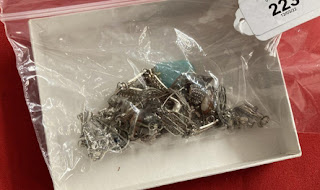
 of a gap in my auction-going, and by the time I'd renewed my interest Covid had come along and put a stop to all manner of public gatherings in confined spaces. Unlike the hospitality sector though, where restaurants, bars and theatres suffered hugely, the auction game carried on online instead, with bidders registering with a particular auction and able to bid from the comfort of home. The only downside was the inability to go and view the lots on sale; instead we were left scrutinising photos on our computer screens or phones, and I can tell you that while most auctioneers know their business backwards, they're not all good photographers. So there was increased risk in online bidding due simply to the fact that you couldn't pop down to the auction house and inspect the goods.

My third tip tip therefore is: do your homework. All auctioneers are on the end of the phone and will be happy to give you more detail about a lot, and maybe even post more detailed images, so if in doubt, ask. Your homework should also however include some online research, particularly to help identify the likely value of a lot.

Image: chards.co,uk
The beauty of the Internet is that you only have to type in, say, 1965 Winston Churchill crown and you will quickly find that - spoiler alert - it's sadly not worth anything more than the five shillings it represented at the time of minting. Which is a bit of a bugger as I've got one. On the other hand you might stumble across a George III rosewood tea caddy in an auction and discover that an exact same box is for sale through an antiques dealer for almost £600, while the estimate the auctioneer has placed on it might be somewhere between £80 and £120. But that brings us to another important tip: don't get too excited about the estimates!

Auctioneers often put estimates on lots to manage your expectations (or even just possibly to inflate the value of an item? Maybe?). Sometimes a lot will have a reserve - a minimum amount agreed with the seller which determines the lowest amount it will be sold for. But the upper end of the price could be anything and is usually determined by how fierce the competition is among the bidders. So, your research should help you decide what you personally will be prepared to pay for something at auction, the actual value being somewhere between the auctioneer's estimate and the commercial value of it if bought through a retailer. But that brings us to the reason for your bidding.

Art is a matter of personal taste. Love it? Buy it!
Image: Great Western Auctions Ltd.
If you're going to bid on an item because it's something that really appeals to you, something you've always wanted, an item say that would be absolutely perfect to fill that empty niche in your study, or a piece of art that is of something or somewhere that resonates with you, then you're bidding from the heart, which can be a dangerous thing if you bid too high. On the other hand, if you really love the object, well, maybe it's worth it.

But if, as I do occasionally, you're bidding on something with the sole aim of selling it on to make a few quid, then you owe it to yourself to accurately determine its resale value before bidding, knowing how much you're wanting to make on it, and taking into account the extra costs involved such as the auction registration fee, the buyer's premium (basically a commission payment), and any packing and delivery charges. 

You can do all the research and hard work you like, but there's also a real element of luck, as I know from personal experience, so permit me to gloat for a moment or two. 

Image: Anon. to save embarrassment
Not all auctioneers are equal in their abilities to accurately catalogue a lot. Some may not even know what an item is, and therefore they go for a minimal description, as happened when I saw our local auction house (name withheld to avoid excruciating embarrassment to them) auctioneer Paul (name changed etc.) describe one particular lot as 'Vintage box'. Now I like small old wooden boxes, but I recognised that this was most likely a tea caddy, apparently made of mahogany. It was included in a general auction rather than a specialist antique sale, which meant my fellow invisible online bidders were less likely to be antique experts. So it proved. When the hammer fell I found I'd bought the box for £14, (£16.80 including fees).

After getting it home and learning a lot more about it (including that it actually was a tea

caddy) I was able to do some more definitive research online. It turned out to be a George III rosewood mahogany tea caddy by Chippendale circa 1780, one of which I found for sale by an antiques dealer for £580 (see pic.). Almost more excitingly I discovered that it has a secret compartment designed to hold the tea mixing spoon, so suddenly it was becoming a real Famous Five type-of find. "I say Julian, just look at this dashed secret compartment! What luck! Timmy, come back with that box you little rascal!"

Of course my initial thought was 'Profit!!!', but we've decided it's too nice a piece to sell just to make a few bucks, so it now resides with us. It's fun challenging guests to find the secret compartment.

Image: Anon. to save embarrassment, again!
A similar thing happened when I saw what appeared to be a vintage tin-plate model biplane in an auction. This time I was able to find it online before the sale, advertised in the USA at US$189. I successfully bid £16, and once again I could hear the lovely ringing of cash registers. But to my surprise my wife Liz loves it, so now it hangs mid-air above the desk in the office in a sort of static victory fly-past.

Not everything has turned out well. I wasted a few quid on a star projector which turned out to be very cheaply made and no use at all, and four bottles of sparkling wine that turned out to have no sparkle and even worse taste, but then wine-buying is always fraught with risk. The annoying thing was not being able to drink it to forget, it was that bad. And I had a close call with a wireless touchpad keyboard which turned out to be not the qwerty English type (despite the picture on the box) but a central European qwertz keyboard. Luckily I was able to on-sell it to a European gent who seemed pleased with the deal. 

My rationale for all this buying and selling is simple: I aim to make sufficient profit on those items I on-sell to offset the cost of those that I wish to keep, so ultimately - even without selling the antique tea caddy at enormous profit - I have still ended up owning a heap of stuff that's cost nothing.

To be fair I put a real effort into marketing the on-sell items to best effect, and I always try and take multiple high quality images supported by accurate and detailed descriptions to attract buyers. I haven't had any complaints. But don't get me wrong, some items prove hard to move and one has to be patient. I currently have a new Landrover Discovery power steering pump that's proving hard to sell, but then I did only pay £5 for it. 

I use Facebook Marketplace to offload most items as there are no selling fees. In the past few months or so I've sold a Victorian silver plate wine funnel, a trail wildlife camera, at least three watches, a wireless microphone, two zoom camera lenses, a model Spanish galleon, and a violin.

Not a reproduction. Cost £10; value at least £150
But there is enormous pleasure in successfully bidding on something that turns out to be valuable, such as the used-but-working Citizen Eco-watch that was listed as a reproduction. I took a risk and got it for £10, then took it to a watchmaker who confirmed it was the genuine article. New they sell today for £600, and even second-hand rarely go for less than £150.

I told the auctioneer about it and he just chuckled and said, 'That's the fun of auctions I guess'. He took it well I thought. Then he told me about how he made a major error in the first few weeks of starting his auction business: 'Some bloke bought a pair of jeans from an early lost and found sale,' Paul said, 'and after he'd collected them he took them home and checked the pockets... and found $3,000 in Canadian dollars!' He chuckled again, and added, 'We don't sell lost luggage items any more - too much hassle.' 

I couldn't bring myself to tell him what the 'vintage box' was worth.


Where I do my online auction buying: Easy Live Auction