Mike Bodnar reveals how his research into 1967 Britain delayed finishing his book by a year...
I started writing my spy thriller Unity in February 2021. The date is etched in my memory - all authors remember when they started a work, and what it was like to get those first few words on the page, knowing that the other 200 to 300 pages to come were still blank. Emptiness stretched before me; it was literary high-diving into the unknown.
An organic thing
But while every author starts with a blank page or screen, authors en groupe do not share a common way of working. Some plan and map out their novels in extreme detail, knowing chapter by chapter what they will be writing about. Others draw diagrams, with circles, boxes and arrows linking characters, plot and sub-plots, with dramatic high points highlighted.
Still others, like me, just start writing, with only a notion inside their head as to where their story is going. That's fine though; each to their own. But this latter leap-of-faith writing-as-it-comes approach is the way it works for me. I guess in today's parlance I write organically.
However, once I'd started writing Unity I soon found that I was easily distracted, because as my novel is set in 1967 Britain - almost 60 years ago - I realised as I wrote that I needed to confirm the memories that I had of those days. And let's be clear, in 1967 I was but 13 years old, so I didn't have adult memories to draw on, only the acne-ridden recollections of a broken-voiced youth who was more interested in science fiction than current affairs.
London, 1967
Which is how I found myself interrupting my writing to do research. Let me give you an example from the book: Chapter 2 - Virgil Street Garage, London. Here I was just about 100 words into the story and I needed to find a real street in which to site the 'government garage.' So off I went into Google Maps, checking out satellite and street views, and found Virgil Street, not far from Waterloo Station and also not too distant from MI6 headquarters, Century House.
I wanted a real street so that I could actually see it (I did even go and visit) and write about it factually. There is no garage there, but there's a decent space where one could have been 60 years ago.
Century House too caused me to detour onto the Internet; I needed to confirm where the headquarters of MI6 were located in 1967, and it turned out to be at 100 Westminster Bridge Road, a tower block that today is re-clad and refurbished as apartments. Almost 60 years ago it was London's worst-kept secret, and any cabbie could take you there or show you where it was if you asked.
Century House today
Geographical locations aside, I also wanted to establish the zeitgeist of 1967 by correctly referencing such common objects as telephone kiosks (I do remember how pongy they smelt inside, of tobacco smoke and worse), and the motor vehicles of the time: Rovers, Austins, Ford Cortinas and so on. I even researched the factory colours for the Ford Cortina used by Russian undercover agent Lillian Grimes and her partner Dmitri.
When MI6 Director General Stone lunches with Foreign Secretary George Brown (for it was he) at the Savoy Grill, Brown is so distracted by news of a top intelligence operative resigning that he fails to read the menu, and instead says to the waiter, 'Tell Silvino I'll have whatever he feels would go best with the '55 Cheval Blanc.'
Silvino was the name of the head chef at the Savoy at that time, should you care to research it for yourself. And yes, 1955 Chateau Cheval Blanc was indeed a fine Bordeaux vintage.
My point is that I thoroughly enjoyed chasing information down rabbit holes on the Internet, and I learned more than a few interesting things about the people, places and politics of 1967 Britain. I also became quite knowledgeable about the Browning Hi-Power .9mm pistol, how many rounds it could hold (13) and what its pedigree was (It was also the standard issue firearm to members of the SOE, the Special Operations Executive).
In fact, I often got so absorbed doing the research that almost a whole day would go by with hardly a single page of Unity written, and I have a feeling that had I just concentrated on writing the book instead of going off at tangents it would have been ready for publication a whole year before it was in fact released.
A Browning Hi-Power .9mm
So, what difference does it make whether such details are accurate? Maybe it doesn't matter to you, but there are pernickety readers out there who would delight in finding inconsistencies or historical inaccuracies in a novel, and more than a few reviewers who would use those as ammunition to shoot down self-published novels as being sloppy or lazy. I didn't want to give anyone the opportunity for such schadenfreude, but equally I wanted the story to ring true to anyone who read it, critic or not.
Above all, I wanted to believe in what I was writing myself; the research helped me visualise my characters, how they spoke and acted, whether they smoked, drank bitter or vermouth, wore a hat, or how they determined distance on a map without the aid of Google or the UK Distance Calculator app.
The melange of real people - especially the politicians of the day such as George Brown, Alec Douglas-Home, and Prime Minister Harold Wilson - adds weight to the story too, and I as an author felt safe in the knowledge that I wouldn't end up in court for using them: you can't, as a writer, defame the dead. Anyway, Foreign Secretary George Brown really did have a drinking problem, and there were rumours within the intelligence community that there was a plot to oust Harold Wilson. 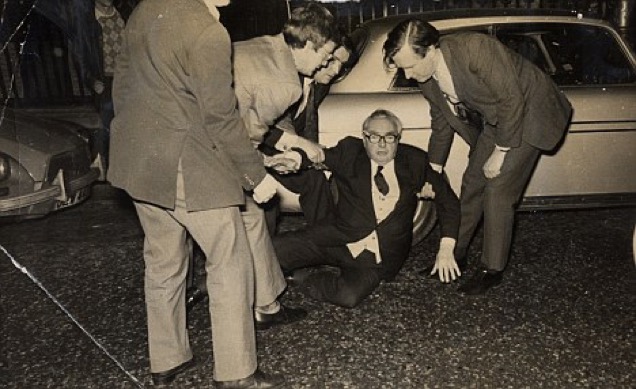
Foreign Secretary George Brown,
'tired and emotional'
My reward for spending so much time on the research comes in the form of feedback and reviews. One perceptive comment, by a doctor of literature no less, notes, 'It's sharply honed thriller-writing, comparable with the very best in the field. Amongst the reading pleasures are the clever and devastating links to 60s political figures and what I call the 'faction' effect: you find yourself wondering: 'Is this actually fiction or has the author got the lowdown on what actually happened?'
Another says, 'I'm staggered with the quality of the writing and the attention to detail.'
Perhaps the highest compliment comes from veteran actor Derren Nesbitt (star of The Prisoner, Where Eagles Dare, Special Branch and, more recently, the acclaimed movie Tucked) who emailed to tell me that he thinks I am 'a very fine writer... very talented' after he'd read Unity.
Actor Derren Nesbitt
I seriously doubt many readers ever bother to investigate whether certain events in novels actually happened (I mean, they are novels after all, works of fiction), or whether some of the characters were real, but in the case of Unity I don't mind if they do check. I did deliberately include extra background information at the end of the book highlighting some of the realities, such as biological warfare experiments undertaken on the British public without their knowledge, details about the British intermediate range ballistic missile the Blue Streak, and Section VII, a division of MI6 which, during World War 2, trained young people as saboteurs, resistance fighters and even killers. That end section is designed to make you go, 'Wow! Really?'

Please excuse me, I have much research to do...
Mike's next book The Liscannor Intercept should be out before Christmas 2023 (but might not be!)


