Showing posts with label journalism. Show all posts

Friday, 17 December 2021

By Any Other Name

Pedestrian and auction-goer Mike Bodnar wonders how and why tabloid journalists label people in the media...


Source: Petty Images
I am writing this as an author. But at the same time I'm also a DIY enthusiast, and I'm keen on astronomy and all things space. I read mystery thrillers and spy novels. I am an old boat owner (in both senses) and I'm a whole lot more, but for the purposes of this article I'm simply a writer. That, however, would be of little interest to journalists from the Daily Mail, the Sun or the Daily Express. It's not exciting enough.

Tabloid journalists, you see, are more interested in providing extra and sometimes-tenuous contexts to those who feature in their stories so that readers will be drawn in, gasping to know more. A mini-survey I've conducted just over the past three days revealed (another word the media loves to use; Mike Bodnar can now reveal...) that a Celtic fan, a new mum, and a widowed pensioner all had something bad happen to them. And that's not even mentioning the other footy fan or the Durham student. But I have anyway.

The point is that in many, if not most, cases, the status of the subject featured in the story has little or nothing to do with the story itself. Take for example the headline, 'Celtic fan, 36, will stand trial over Captain Sir Tom Moore tweet.' 

The first thing you discover on reading the article is that the fact the man was a Celtic supporter has absolutely no relevance whatsoever to his having been charged with sending an abusive Tweet. Neither for that matter does the fact that he was 36 years old. If I were a Celtic fan I'd be fuming about the subtext of this, vis: Celtic fans are right bastards to old people, especially when in their mid-thirties.

This tendency to label people in media stories as something more than they are is presumably to increase the shock-horror and tut factors. Somehow we are likely to be more gobsmacked that a Celtic fan would dare insult the dearly departed Captain Tom than if we'd been told, 'Man on trial over abusive Tweet.' Man? Who cares? Celtic fan (36)? Tut!

Meanwhile, a 'mum' was ordered by a local council to take down a Christmas wreath from the front door of her council flat due to health and safety concerns. The story is laughable enough for its absurdity, yet the Sun newspaper (I use the term loosely) felt it necessary to add motherhood into the mix. The fact that her daughter is actually 19 has very little to do with the story, but of course we are supposed to feel increased sympathy for the (apparently) single parent. Since the headline wasn't, 'Wife told to pull down wreath' we can't tell. Maybe we should be furious she's not married. I shall write to the Pope.

That esteemed organ the Daily Mail was pleased to inform us that, 'Durham student, 21, loses court battle with aunt over mother's will.' I was so relieved that it wasn't a student from Glasgow, or Leicester. Phew. Also, so she's a student, do we care? Well yes, I guess we're supposed to have sympathy for all students due to the horrendous cost of education, but in fact the story reveals (there's that word again) that she needed the money to put a deposit on a house and to buy a polo pony. Well diddums. 

But in contrast to the Durham student (21), the Daily Mail also brings us the heart-warming news that  'Father-of-two, 44, finds £100,000 medieval brooch.' I always find archaeological discoveries fascinating, and in this case the brooch could be around 800 years old, unlike the finder who, as you know, is just 44.

More frustratingly though is that the dad's two kids don't even get a mention in the story, so it's hard to see what relevance there is in telling us they exist. The dad himself is an architectural technician, but maybe that was too wordy to fit in the headline; father-of-two is easier on the eye. 'Man' might have been even better.

'Man' also wouldn't do for the Mirror's story: ' 'Extremely popular' football fan, 46, dies after being unable to get Covid jab.' Although sad, the extremely popular man (46) would have died if he'd been a train spotter, a twitcher, or an orchid grower. Being a football fan doesn't make you any more susceptible to Covid, although there is the danger of close bodily contact with like-minded sweaty fans on the terraces, so maybe the Mirror was doing us a public service. 

Turns out Mr Popular was also 'quite outdoorsy' and was a keen martial arts exponent, but for some reason the Mirror hacks decided 'football fan' would be more of a headline drawcard. And seriously, there's something a bit tacky about telling us he's 46 when he's not any longer.
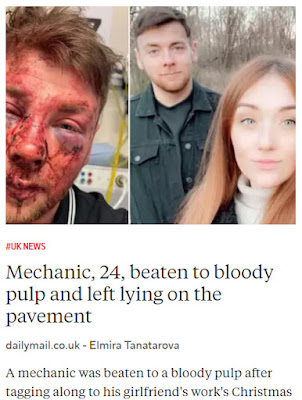
The Mail Online meanwhile informs us that a mechanic was beaten to a pulp outside a nightclub. Are we supposed to assume that if he'd been at work and had a hammer or wrench to hand he could have fended off his assailants? That his lack of proximity to his Snap-On toolbox put him at a disadvantage? 

Of course not; it was 2.30 in the morning. So what possible context can there be in his being a mechanic (24)? None, but the media hacks desperately need something to put in the headline, and an occupation or interest will do. 

Oh, and an age, of course, because we all want to know how old someone is, said the author (67) of Sunbury-on-Thames.

I'm not highlighting anything new; this sort of sloppy irrelevant so-called journalism has been around for years, as has the British tabloids' tendency to label criminals 'yobs,' 'thugs,' and 'louts.' The Court of the Tabloids is judge, jury and executioner in one.

It's just that I miss the days when reporting was balanced and neutral and we could all form our own opinions after reading an article, and go 'tut' or shake our heads and comment 'shocking' as required. Or indeed move on and form no opinion at all. But we live in an age of extremes and extremists. And terrorists. Britannica.com says that terrorism: '...seeks to create fear, not just within the direct victims but among a wide audience.'

That seems to me what the tabloids are doing with some of their stories: seeking to create or highlight fear. I'm in fear every time I read any news, and you may well blame me for doing so. 

Well, let me make it clear that I certainly don't read the tabloids, but sometimes their headlines pop up uninvited in my daily feeds on Flipboard and I can't help but notice them. But instead of letting myself be unsettled by stories of yobs and louts, I instead take some pleasure out of analysing the policies and thought processes of modern journalism and the media in general, and try to work out the rationale behind the different reporting styles. I haven't reached any firm conclusions yet, other than the media sector is so competitive that the papers, radio and television news programmes will grasp at anything to make a headline.

As I said at the start, I am at this moment a writer. When I go upstairs to prepare dinner I am a husband (and chef). When I stroll round the block I'm a walker, and when I watch the International Space Station go overhead I'm a space geek. I can be a driver, a boater, a cyclist or a pedestrian at any given time, which obviously the tabloids love. 

We are all different things at different times, so - I can now reveal - I've asked my wife that, should I suffer another heart attack she is to advise the media of my status accordingly so that there can be no doubt.


.


Wednesday, 20 January 2021

Keep Clam and Proofread

I am writing about mistakes in writing, which in itself is fraught with risk. Because the first thing you're going to do as a reader is look for errors in my article on errors, so perhaps I should apologise right up front if you find any. I can only say mea culpa in advance, and add that I am not particularly taking a 'holier than thou' position, merely trying to illustrate how infuriating and diverting mistakes can be.

So, caveat out of the way, let's get started with a sweeping generalisation: Contemporary journalism, especially online, is riddled with grammatical and spelling errors. And such errors totally spoil the impact of a headline or the credibility or even readability of an article. Or all three.

As a qualified curmudgeon I have recently been on the lookout for examples of literary languidity (which is a word I just made up, before you comment), examples which showcase listlessness and carelessness in headlines and body copy. 

Why? Because I see such things on a daily basis, in fact so often now that it calls into question whether journalists and their sub-editors are even reading what they've written before they publish.

I decided therefore to start collecting a few of these examples to share with you by way of evidence. Much to my non-surprise I found more than enough in just a day of normal casual browsing. Had I maintained my vigil for a week I could have completed a whole compendium of crap, but I think the ones I showcase here today will be enough. 

Let's start with an error worthy of half a million comments, about the NHS and how many of its workers have had to pay around £500,000 for parking at one hospital trust alone. As you can see in the screenshot, the £500k is described as 'hald a million', because, presumably, the sub-editor is working from home during the pandemic and allowing his/her cat to walk across the keyboard. But then, it is from the Mirror, so what can you expect?

Also, hald a million what? Even the body copy doesn't say. Here in the UK we know it means GB pounds, but in other countries they may think it was pesos, or zloty.

Whatever the currency, the Mirror isn't paying its hacks enough, obviously.

Then there's the woman who 'has went' viral online, according to the Daily Record. This mistake is likely because the journalist had originally written that the woman 'has gone viral' and then changed it to 'went viral' but without fully deleting the original draft. 

I saw read this online earlier...
Easy to do, but does this illustrate the larger problem, which is that journalists online are under tremendous pressure to get stuff published as quickly as possible, to beat the other online organs to the finish line, and therefore to be the ones 'breaking' the story? (Just nod).

Back when I was a lad ('were a lad'- Ed.) newspapers were physical things made of actual paper, that came out daily, sometimes twice-daily. Although they still had publication deadlines to meet, there was a strict chain of editorial command which acted as an increasingly fine-mesh filter system to spot and correct mistakes before the presses started rolling.

In today's digital environment however, content is king, and having up-to-the minute stories is vital if your organ's online status is to be credible and clickable. But the pressure to get content online creates its own problems - the faster you rush something into 'print' the less time there is to proofread and the more chances of mistakes getting through.

Mistake been made, reader am bemused
Which is almost certainly what happened at the BBC a couple of days ago where a missing 'has' changes the tone of this piece to one of pidgin English, rather than the polished delivery we've come to expect from Auntie Beeb; see the clipping, and smirk.

Here are a few more from my casual collection...

Americans 'air' giving Trump low marks. Just as we are giving really low marks to the staff writers at Audioburst. Using spellcheck or apps such as Grammerly probably wouldn't pick this error up as 'air' is spelt correctly, and Americans are quite likely to air something, such as their opinions, or underwear. (Also, who is President Trump Low? I rest my [upper] case).

Meanwhile, DIY enthusiasts will be agog to learn that they can put up a shelf in just '30 minute.' (That said, here in the UK it is very common for people to say that they were doing '80 mile an hour' on the motorway, though this could be a peculiarly northern thing - I haven't heard it much here darn sarf).

But the missing 's' again turns the headline into pidgin English, or maybe it just reflects the way the DIY instructions are written: Take shelf. Mark shelf position on wall. Use spirit level, make straight. Drill holes. Slip drill bit onto thumb. Swear. Sit down, read stuff online. See article: 'Plant shelf takes 30 minute to make.' Pour wine.

Why you write it like this, huh?
Forbes, which should know better, turns a question into a statement, and it's not rhetorical. Once again the urge to publish quickly results in a headline that is rendered meaningless by the simple inclusion of an errant question mark. If it had started with, 'Why should you...' the interrogative would have made sense. As it is it's neither one thing or the other.


This just to hand...
Finally though, not a headline or copy error, just an incredibly sloppy piece of knee-jerk publishing, and again from the BBC. 

On Monday a classic motorcycle museum in Austria caught fire and was totally destroyed, along with the valuable collection of 200 bikes inside.

In its rush to get the story out it looks as though a hack has searched for 'motorcycle museum fire' and published the first story that came up, which was indeed about a disastrous motorcycle collection blaze - but from Birmingham in 2003. 

No spellcheck or app would pick that up, only a measured, diligent approach to journalism, which, in our hectic, competitive and breathless digital age, seems to be missing.

Now if you'll excuse me I must go and proofread what I've just written - about 15 times.


But wait, there's more! This just in...