Friday, 7 January 2022

The Meteoric Rise of Space Misinformation

 Mike Bodnar highlights why some media science is just astronomically wrong... 


As you can see from the headline of my opening image, someone has captured brilliant photos of Comet Leonard 'streaking' through the night sky. 

And sure, it really does look like it's hurtling through space, what with that long elegant tail streaming out and all. 

But I have to disabuse you of something: comets don't streak, at least not in our skies. They move infinitesimally, incrementally, night after night. (Unless, of course, you're watching Don't Look Up, in which case it's time to kiss your ass goodbye)

Sure, up in space they really are hurtling; Leonard's a fast kinda guy - barrelling along at an estimated 158,084 miles per hour (254,412 km/h or 70.67 km/second), but due to the vast distance between us and Len, we don't see that speed here on Earth. 

Imagine you're in an aircraft at 35,000 feet looking down on a desert highway below. You can see a vehicle. It doesn't appear to be moving, well maybe not much. But now imagine you're a hitch-hiker standing on the side of that same road. The car approaches and suddenly zooms past you, doing, let's say, 90 miles per hour. Whoa, that's fast! It just blew the cardboard hitch-hiking sign out of your hand! And they didn't stop! 

Unfortunately, the media tends to use words like 'streak,' 'zoom,' and 'shoot' when referring to comets, which - for those who've perhaps never seen a comet before - raises expectations of some sort of spectacle where the celestial object is going to put on a display you'd expect to see at a fireworks event.

Don't get me wrong - comets can definitely be spectacular, but we've had only nine significant comets - that is, comets visible to the naked eye during daytime - in the past 300 years or so. 

Comet McNaught. Image: Mike Bodnar
One of the more recent was Comet McNaught, named after the Australian astronomer who discovered it, and which could be seen in 2007. 

Visible mainly from the southern hemisphere, some reported they saw it in daylight, but from where I was at the time - in Wellington, New Zealand - it required a keen eye and a dark sky without light pollution just after sunset to see it at all. But I did, just - see the pic and play Spot the Comet.

Which brings us to one of astronomy's biggest enemies: light pollution. Too many journalists rave that a comet 'can be seen' in a particular part of the sky without mentioning that if you live in a city you're unlikely to see anything at all due to light pollution. Some comets are so faint you need truly dark skies, such as those in Northumbria, a designated 'dark sky area,' to see anything.

And before we leave comets, may I just touch on the tail? A comet's tail develops more as it gets closer to the sun, due to the sun's influence on the actual comet which is an icy ball of rock and dust. The tail doesn't so much streak behind the comet as demonstrate which way it's oriented. That is, the tail will always face away from the sun regardless of the comet's direction of travel, because the ice and dust being burned off streams out away from it. So it's not, for example, the same as a boat's wake in the water, which will always be behind the boat and away from the boat's direction of travel.

No. Just no.
So even when a comet has passed the sun it's tail will still point away from it. Therefore, not only is a comet's tail nothing to do with its streaking, hurtling speed, it means you will likely best see a comet either just after sunset or just before sunrise. Unless of course it's one of those once-in-a-lifetime big buggers.

Now let's come to meteors. More specifically of course, meteors come to us, but once again the media rave about meteor showers putting on a 'spectacular display,' or that they will be 'stunning.'

Before we get into why some of that hype is only partially true, let's look at the media image here, which announces that a 'stunning' meteor shower is to take place over the UK.

Firstly, the image the tabloid has used does not show meteors; it shows star trails captured in a time lapse by a camera. Never will you see this with the naked eye because we as humans don't have the ability to slow down time and observe it thus.

Don't get me wrong - it's a lovely picture, but the picture editor has been lazy and chosen something that they think looks 'stunning,' and, in their ignorance, they have once again skewed readers' expectations of what they might see.

A meteor caught on camera. Image: iNews
Meteors are basically bits of space rock that burn up as they enter Earth's atmosphere. Unlike comets they really do streak, sometimes so fast that if you blink you'll miss them. 

There are two main categories of meteors (sometimes called shooting stars): we have random meteors, which arrive unexpectedly and take us by surprise, and meteor showers, which are predictable.

Meteor showers are predictable because Earth's orbit, which is also predictable, passes through various known fields of rocky space debris as it goes around the sun, but the term 'showers' itself raises expectations.

A really good meteor shower could mean that, in a nice dark sky location with no clouds, you might see on average 50 meteors an hour, obviously an average of just under one per minute. But you're most unlikely to see a whole heap of them burn up in the atmosphere at the same time like fireworks.

Seeing 50 in an hour is, in astronomy-speak, truly stunning, but to the everyday non-astronomical bystander it's almost yawn territory, and in this day and age of short attention spans, many people want spectacular or stunning to mean that they can look at the sky for five minutes with a glass of Sancerre in their hands and be amazed at the spectacle above them.

So when the media rants about how spectacular a meteor display will be, take it with a grain of salt. Also check the weather forecast, make sure you're prepared to travel to a dark sky location, and take a comfortable folding chair, a flask of coffee, warm clothing, and lots of patience. Look up and enjoy.

The spectacular Arizona Crater formed by a large meteor impact.
Remains of the meteorite can be seen in the crater's information centre. Image: Mike Bodnar

Before we leave meteors, a couple of clarifications. Firstly, when people talk about having had a meteoric rise in their careers, they're meaning it was fast. Meteors don't rise - they only fall. Secondly, when a meteor burns up completely in the atmosphere it remains a meteor. If parts of it fall to earth then they become meteorites. Just saying.

Asteroids meanwhile are rocks in space. They're a bit like comets except with little or no ice and less dust. They're the stuff of disaster movies, and famously one has been found guilty of wiping out the dinosaurs and a large portion of other life on Earth when it entered our atmosphere and struck the planet 65 million years ago.

We're all going to f***ing die!
Advances in astronomy and detection technology in recent years mean that we now know of many many asteroids, and scientists maintain vigil over their orbits and paths, especially in relation to Earth. Most pose no threat whatsoever, but in recent years the media has thrilled to the concept of an asteroid having a close encounter with Earth, using phrases such as, 'Near Miss,' Brush with Extinction,' and, last November, 'Concerning asteroid will break into Earth's orbit in a week.' Quick, duck!!!

The story originated in a tabloid and was quickly picked up by other organs for its shock-horror value. The accompanying video began with, 'A giant asteroid is heading towards Earth.' Well, if you were just a headline reader you'd be running screaming for the hills, or walking through a park a la Jennifer Lawrence in Don't Look Up telling everyone, 'You're all going to f***ing die!'

You have to read further into the article to learn that not only was the asteroid not heading for Earth, it would be about 10 times as far away as the moon at its closest approach and poses no threat whatsoever. But a headline that says, 'No Threat Posed By Asteroid' doesn't grab readers. Or terrify them. Or sell newspapers.

Oh dear.
Image: Getty Images, as used by the NY Post
And note that the headline says the rock would '...break into Earth's orbit.' Forgive me, but many people would read that and assume it meant Earth's atmosphere, which, if it were true, certainly would require Jennifer Lawrence to comment. 

A good analogy would be: you're in your car and you join the M25 ring road around London at a point in the south. At the same time a petrol tanker crosses the same motorway in the north on an overpass. You are, if you like, briefly on the same orbit around London, but the chances of you crashing into that tanker and dying horribly in a roaring inferno are pretty much zero.

In short, you are more likely to suffer ill health and mental issues reading tabloid hype than you are of dying in an extinction event caused by an asteroid.

Finally, let's turn our metaphorical telescopes to the moon and the hype that's been promulgated by the media about our nearest celestial neighbour.

I'm not talking about NASA's or billionaires' plans to send people there or build lunar colonies; I'm talking about the hype surrounding all the different names given to the full moon every time one comes around, which is approximately monthly.

Lunar eclipse, or Blood Moon.
Image: Mike Bodnar
You've heard them: there's the wolf moon, the blue moon, the blood moon, the pink moon and
so on. Bollocks. In the end, the only one that will look any different would be a 'blood' moon, which actually just refers to the red colour it turns during a full lunar eclipse when the Earth's shadow passes across it, which is a rare event. All the others are names drawn from myth and legend, or, like the harvest moon, the seasons. The full moon, for the most part, whatever it's named, will just look like it always does.

That said, never pass up an opportunity to look at the moon and marvel at our nearest neighbour. Use binoculars to see craters, and the so-called 'seas,' or use a telescope for even more detail. Avoid doing this during a full moon because the whole surface is lit up uniformly by the sun; far better to view it when it's a crescent, or a half moon, when you can marvel at the craters in relief along the sunlit edge.

So, my advice about all things celestial is: don't believe all the media hype, but do always look up when you get the chance. Marvel at the night sky, not at the media headlines.


Friday, 17 December 2021

By Any Other Name

Pedestrian and auction-goer Mike Bodnar wonders how and why tabloid journalists label people in the media...


Source: Petty Images
I am writing this as an author. But at the same time I'm also a DIY enthusiast, and I'm keen on astronomy and all things space. I read mystery thrillers and spy novels. I am an old boat owner (in both senses) and I'm a whole lot more, but for the purposes of this article I'm simply a writer. That, however, would be of little interest to journalists from the Daily Mail, the Sun or the Daily Express. It's not exciting enough.

Tabloid journalists, you see, are more interested in providing extra and sometimes-tenuous contexts to those who feature in their stories so that readers will be drawn in, gasping to know more. A mini-survey I've conducted just over the past three days revealed (another word the media loves to use; Mike Bodnar can now reveal...) that a Celtic fan, a new mum, and a widowed pensioner all had something bad happen to them. And that's not even mentioning the other footy fan or the Durham student. But I have anyway.

The point is that in many, if not most, cases, the status of the subject featured in the story has little or nothing to do with the story itself. Take for example the headline, 'Celtic fan, 36, will stand trial over Captain Sir Tom Moore tweet.' 

The first thing you discover on reading the article is that the fact the man was a Celtic supporter has absolutely no relevance whatsoever to his having been charged with sending an abusive Tweet. Neither for that matter does the fact that he was 36 years old. If I were a Celtic fan I'd be fuming about the subtext of this, vis: Celtic fans are right bastards to old people, especially when in their mid-thirties.

This tendency to label people in media stories as something more than they are is presumably to increase the shock-horror and tut factors. Somehow we are likely to be more gobsmacked that a Celtic fan would dare insult the dearly departed Captain Tom than if we'd been told, 'Man on trial over abusive Tweet.' Man? Who cares? Celtic fan (36)? Tut!

Meanwhile, a 'mum' was ordered by a local council to take down a Christmas wreath from the front door of her council flat due to health and safety concerns. The story is laughable enough for its absurdity, yet the Sun newspaper (I use the term loosely) felt it necessary to add motherhood into the mix. The fact that her daughter is actually 19 has very little to do with the story, but of course we are supposed to feel increased sympathy for the (apparently) single parent. Since the headline wasn't, 'Wife told to pull down wreath' we can't tell. Maybe we should be furious she's not married. I shall write to the Pope.

That esteemed organ the Daily Mail was pleased to inform us that, 'Durham student, 21, loses court battle with aunt over mother's will.' I was so relieved that it wasn't a student from Glasgow, or Leicester. Phew. Also, so she's a student, do we care? Well yes, I guess we're supposed to have sympathy for all students due to the horrendous cost of education, but in fact the story reveals (there's that word again) that she needed the money to put a deposit on a house and to buy a polo pony. Well diddums. 

But in contrast to the Durham student (21), the Daily Mail also brings us the heart-warming news that  'Father-of-two, 44, finds £100,000 medieval brooch.' I always find archaeological discoveries fascinating, and in this case the brooch could be around 800 years old, unlike the finder who, as you know, is just 44.

More frustratingly though is that the dad's two kids don't even get a mention in the story, so it's hard to see what relevance there is in telling us they exist. The dad himself is an architectural technician, but maybe that was too wordy to fit in the headline; father-of-two is easier on the eye. 'Man' might have been even better.

'Man' also wouldn't do for the Mirror's story: ' 'Extremely popular' football fan, 46, dies after being unable to get Covid jab.' Although sad, the extremely popular man (46) would have died if he'd been a train spotter, a twitcher, or an orchid grower. Being a football fan doesn't make you any more susceptible to Covid, although there is the danger of close bodily contact with like-minded sweaty fans on the terraces, so maybe the Mirror was doing us a public service. 

Turns out Mr Popular was also 'quite outdoorsy' and was a keen martial arts exponent, but for some reason the Mirror hacks decided 'football fan' would be more of a headline drawcard. And seriously, there's something a bit tacky about telling us he's 46 when he's not any longer.

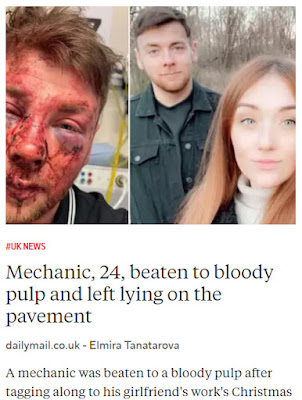
The Mail Online meanwhile informs us that a mechanic was beaten to a pulp outside a nightclub. Are we supposed to assume that if he'd been at work and had a hammer or wrench to hand he could have fended off his assailants? That his lack of proximity to his Snap-On toolbox put him at a disadvantage? 

Of course not; it was 2.30 in the morning. So what possible context can there be in his being a mechanic (24)? None, but the media hacks desperately need something to put in the headline, and an occupation or interest will do. 

Oh, and an age, of course, because we all want to know how old someone is, said the author (67) of Sunbury-on-Thames.

I'm not highlighting anything new; this sort of sloppy irrelevant so-called journalism has been around for years, as has the British tabloids' tendency to label criminals 'yobs,' 'thugs,' and 'louts.' The Court of the Tabloids is judge, jury and executioner in one.

It's just that I miss the days when reporting was balanced and neutral and we could all form our own opinions after reading an article, and go 'tut' or shake our heads and comment 'shocking' as required. Or indeed move on and form no opinion at all. But we live in an age of extremes and extremists. And terrorists. Britannica.com says that terrorism: '...seeks to create fear, not just within the direct victims but among a wide audience.'

That seems to me what the tabloids are doing with some of their stories: seeking to create or highlight fear. I'm in fear every time I read any news, and you may well blame me for doing so. 

Well, let me make it clear that I certainly don't read the tabloids, but sometimes their headlines pop up uninvited in my daily feeds on Flipboard and I can't help but notice them. But instead of letting myself be unsettled by stories of yobs and louts, I instead take some pleasure out of analysing the policies and thought processes of modern journalism and the media in general, and try to work out the rationale behind the different reporting styles. I haven't reached any firm conclusions yet, other than the media sector is so competitive that the papers, radio and television news programmes will grasp at anything to make a headline.

As I said at the start, I am at this moment a writer. When I go upstairs to prepare dinner I am a husband (and chef). When I stroll round the block I'm a walker, and when I watch the International Space Station go overhead I'm a space geek. I can be a driver, a boater, a cyclist or a pedestrian at any given time, which obviously the tabloids love. 

We are all different things at different times, so - I can now reveal - I've asked my wife that, should I suffer another heart attack she is to advise the media of my status accordingly so that there can be no doubt.


.


Sunday, 21 November 2021

Putting Our Nationality Behind Us

 Mike Bodnar contemplates the bumpy road ahead for drivers after leaving the EU...


The now-compulsory UK sticker
One of the consequences of leaving the European Union is that drivers of British cars, when they journey overseas, must now display a specific sticker on their rear identifying their country of residence. Not on their bums obviously, on the rear of their vehicles. Come on now, behave.

Prior to joining the EU in 1972, such stickers were common, and declared the vehicle to be from Great Britain, with the initials GB, black on a white oval background. Upon becoming part of Europe however, these stickers were no longer necessary, since registration plates were changed to include a small ‘GB’ featuring the lovely EU yellow stars. In style and presentation they matched all the other EU number plates, and signified a unity, a togetherness.

But now that Britain has left, divorced, withdrawn and retrenched, we are once again faced with having to declare our nationality on our rears, except now the stickers have been changed from ‘GB’ to ‘UK.’ And we aren’t allowed to use the attractive yellow stars or the EU’s blue background.

Apparently we only learned of this through the United Nations, which issued a memo. But it wasn’t a decree from the Eurocrats – it came from Westminster. A Department for Transport spokesperson told the BBC: ‘Changing the national identifier from GB to UK symbolises our unity as a nation and is part of a wider move towards using the UK signifier across government. We notified the UN of our intention to make these changes in July, and have been working with the sector to implement the change.’

Searching for a United Kingdom
So we are no longer Great Britain apparently, but that much has been obvious for quite some time. There’s little that’s great about a country as torn by racism, crime, homophobia, homelessness, political incompetence, and a mishandling of a pandemic that’s been, well, plagued by ill health from the start, as we are.

Tellingly, the requirement for us to now declare ourselves as being from the UK underlines that we are not part of the Europe Club any more; instead we are on our own, against Europe, independent, maybe even adrift. But – and here I finally arrive at my point - united we are definitely not.

We have the north-south divide in England, Scotland seeks independence, there’s an almost equal split between those Brits who wanted to leave Europe and those who wanted to remain in the EU, an increasing political chasm between the Tories, Labour and any of the other parties, and a general unease about how we should manage ourselves and our international reputation from here on. And I haven’t even mentioned the rich and the increasingly poor. There is little sign of unity.

However, the prospect of bumper stickers declaring us to be from the Disunited Kingdom are slim, since DK is already taken (by Denmark). NSGB would be appropriate, since we’re not-so-Great Britain now, but presents problems to those who design and print the stickers themselves. Instead of being a neat oval, the NSGB sticker would have to be more of a sausage shape. Not a German sausage note - a good old Cumbrian sausage. Or maybe a black pudding. NSUK also invites a wealth of derision. NSUK on this, etc.

Disunited Kingdom might work as DUK, but would open the way for references to dead ducks, duck for cover, and so on. So no, we’ll have no derision here thank you.

Anyway, United Kingdom? I think not. We haven’t had a kingdom since George VI, and although there’s a candidate pacing up and down in the wings as we speak (and has been for decades), we are a Queendom, and have been since 1952. One, at least, is not amused.

But mentioning the Royal Family brings up another thorn in our side, since we are increasingly divided over the relevance of the monarchy. The republican movement might well be rubbing their hands in anticipation of radical change, but the vehicle sticker designers will be holding their heads in their hands in fear of having to squeeze REPUBGB into a standard oval. We’re not talking a sausage shape here; we’re talking a whole salami. But then that’s Italian and would never do, no, no, no.

Maybe we just need to honestly declare ourselves a Free United Kingdom in Disarray.