Tuesday, 30 June 2020

How I almost went to the moon with Spike Milligan


The problem with meeting one of your heroes is that they might just turn out not to be the idol you’d expected. Or that they are but you’re hopelessly ill-prepared for the encounter. In my case – in meeting and interviewing the great Spike Milligan – it was a bit of both.

Flashback to the mid-1980s when I was working as a regional TV newsreader in Wellington, New Zealand. I presented the news on Today Tonight every weekday evening following the national news, but also got to go out and about with film crews doing short features and, if not in the studio, interviewing visiting noters ‘in the field’ as the jargon has it. It was a great job.

Spike Milligan. I copied this image from the Internet
years ago but have no permission to use it.
If you own the rights please let me know
So one day we had the opportunity to interview the great Goon himself, Spike Milligan, who was in town for – as far as I can recall – no particular reason. His great ex-army pal Harry Edgington did, however, live just up the road and it was well known that whenever Spike was in New Zealand he would go and visit Harry, presumably to talk over old times, or listen to jazz records. Maybe he was just there for a catch-up.

Anyway, once we knew we could interview Spike we discussed in the newsroom how we should do it. Obviously we knew Milligan had a reputation for being a comic genius, but he was also known for suffering mood swings; anecdotally we’d heard he hated air conditioning and that it could affect his moods. So we decided to do a field interview, outdoors and well away from any aircon.

His agent and partner Sheilagh had told us Spike would be based at a house in Hobson Street, Thorndon and that we would be slotted into the interview schedule. We arrived in the crew van and ahead of us were Radio NZ and the local newspaper the Evening Post, but we were quite prepared to wait.

Sheilagh came out and asked what we’d like to do and I explained we’d prefer to take Spike just a hundred metres up or so the road and interview him in a leafy park area. She said she’d tell him and departed.

Spike on another park bench, without me.
(Spike Milligan memorial bench, garden of Stephen's House, Finchley
(Image: Wikimedia Commons)
We were feeling quite pleased with ourselves: an interview with the great Spike Milligan, in a park on a nice day where air conditioning wouldn’t be a problem. Perfect.
Suddenly here was the man himself, leaping energetically into our van through the open sliding door. ‘Hello folks!’ he said in his endearing Goonish manner. I introduced myself and the crew and then Spike, still in Goon mode, said, ‘So, what’s happening?’
I told him we’d like to nip up the road and interview him in Katherine Mansfield Park. His face clouded, the Goon disappeared, and he said, ‘Why does every fucker want to interview me in a park?’ So much for air conditioning being a problem.

My heart sank. I could hardly say, ‘Well, Spike it’s so we don’t set off a mood swing’, so I mumbled something about it being a nice day and if we were outside we wouldn’t have to use lighting so it would be quicker. He calmed down after that, and within minutes he and I were seated on a park bench while the cameraman and sound op set up.

I had with me a list of questions, but before the camera even rolled it was Milligan who was interviewing me. He wanted to know what I thought about the Elgin Marbles and whether they should be repatriated to Greece, and what my opinion was of sending men to the moon and “wasting all that money”.
From the cover of 'Monty: His Part in My Victory'
which Spike signed for me

To my shame I had at that time no idea what the Elgin Marbles were. I had a definite opinion about lunar exploration though, which we discussed for a short while. And then the camera and sound were ready and we roll-recorded, at which point I referred to my scripted questions and interviewed Spike Milligan.

To this day I can’t remember what my questions were. I recall Milligan responded well enough, but in hindsight I should have picked up on the nuances and followed the leads he’d given me while the crew was setting up. I should have thrown my script away and said, “Spike, as we were setting up you were asking whether the Elgin Marbles should be returned to Greece. Why? Is that something you’re passionate about?” and we could have had a meaningful discussion about one of the great comic’s many causes, something incisive, in-depth, interesting.

But I didn’t. I was a slave to my script and was guilty of the ultimate sin for an interviewer: not listening to your interviewee. Not long after that I realised that you don’t need a list of questions for an interview, you need only one – the first one – and providing you listen to the answer you can build on it from there.

One of my most treasured possessions
That’s not to say research isn’t important; it is, and it pays to know as much about your interviewee (we called them ‘talent” in those days!) as you can, but really an interview is nothing more than a conversation conducted on behalf of the viewer at home.

And so I did my duty as the programme host and Spike did his duty as the visiting talent. I think we parted friends (he willingly signed one of his Military Memoir books for me), but it could have been so much more interesting had I just been a bit more experienced. I feel I let him down, and I certainly let myself (and the viewers) down, and Spike himself didn’t get the chance to talk about what he was really interested in.

Spike, wherever you are now: yes I do think the Elgin Marbles should be returned, but no I disagree that space exploration is a waste of money. But, too late to discuss that now. Curses, foiled again.


Friday, 8 May 2020

The Road to a Better Future


The Tightly-Furled Umbrella takes a poke at our vehicle usage and wonders whether government intervention might not be a bad thing…


Picadilly Circus, with no performers
As the country has had plenty of time for thinking and general reflection on life’s values over the past few weeks, one of the things to come out of it is that a certain number of us plan to ‘do things differently’ in the future.

This could of course end up being no more binding than New Year resolutions – abandoned after a few weeks when we get tired of the effort – but one aspect that I'm really hoping will change is our use of motor vehicles. Make that 'overuse' of motor vehicles.

I would give anything to go into central London right now and experience the deserted streets with hardly any traffic and almost zero pollution. The peace and quiet would be novel too. But alas I'm not an essential worker (more ‘essentially lazy’ if anything) so I haven’t gone in, and it’s a bit far for me to justify as ‘exercise’.

Traffic cameras showing nearly empty roads on a weekday
But that annoyance apart, it would be wonderful to think that our cities’ streets might be a tad quieter and less congested post-pandemic due to a new realisation that, hey, maybe we don’t need to take the car out quite so often after all. Recent research indicates this could indeed be the case.
According to the UK government, data recently recorded at 275 automated sites show that journeys in vehicles are now around 35% to 45% of the usual level, and even that takes into account ‘creep’. (No, that's not the strange guy who drives past your place looking weirdly at your house – in this instance it means our vehicle usage has slowly crept back up since lockdown was introduced). The Automobile Association has reportedly said traffic volumes in Britain are now 'akin to those in the early 1970s' when they were just one-third of what they are today.
But this is obviously due to the government lockdown restrictions rather than any voluntary commitment on the part of vehicle owners to ‘go green’ or use their cars less for a better world. That said, another recent survey shows that many people are – post-pandemic regulations – expecting their use of buses and trains will drop and, importantly, 24% of those plan to work from home more.

Should the survey results translate into actual changes in behaviours, this could mean we’ll see much less traffic on the roads, drops in air pollution, fewer accidents, and less reliance as an economy on oil and petroleum products. The roads will become a bit safer for cyclists too.

So rather than wait for a voluntary change in behaviour could the government not instead legislate for fewer vehicles on the road? It’s been done before overseas, but did it work, and could it work here?

Flashback to New Zealand, 1979 - the country was facing an oil crisis where imports had become prohibitively costly, with OPEC raising the cost per barrel from US$12 to $19 during the first half of that year. Worse perhaps was the Iranian Revolution, which essentially shut down Iran’s oil industry - 5.7 million barrels per day were withdrawn from the world supply.

So, abandoning sheep shearing contests and leaving their pavlovas to go soggy the Kiwi government leapt into action and introduced the novel concept of ‘carless days’ on 30 July. They also reduced the open road speed limit from 62mph to 50mph.

The scheme – designed to reduce the nation’s demand for, and reliance on, oil imports - required those with private vehicles to nominate one day of the week on which they would not drive their vehicles. This was enforced with the introduction of heavy fines for those caught driving on their selected day. (There were exceptions for rural travel where public transport was almost non-existent, and ‘essential travel’ as in today’s lockdown) The carless days scheme applied only to petrol-powered vehicles and those weighing less than 4,400lbs. The restriction didn’t apply to motorbikes, scooters or mopeds.

NZ's carless day sticker selection. Image: Facebook
Less than a year after it began the scheme was scrapped, partly because it wasn’t popular but also because it didn’t reduce petrol consumption very much. (The reduced speed limit remained in place for a while longer) In principle carless days should have had an impact; private vehicle usage could have dropped by approximately one-seventh, but Kiwis are an inventive lot and many found ways of getting round the restrictions. Owning a second car was one of them (some bought a second vehicle just to avoid the scheme) while others purchased motorbikes.

A scathing newspaper column from the day also shows that an estimated 25 percent of Kiwis had successfully applied for legal exemptions to the scheme.

Obviously it wasn't working...
There’s a memory shared on Wikipedia of a bloke with a motorbike who could sometimes be found riding with his two flatmates as pillion passengers... plus a dog. A few clever Kiwis realised that if you applied for two different day stickers you could cover them in cling-film and easily attach or detach them from your windscreen according to whatever day of the week it wasn’t. Legally you were supposed to have your nominated sticker permanently attached.

But there are other stories – rather like those today from people feeling guilty about flouting the lockdown regulations – where motorists who drove their cars on their nominated carless day ended up feeling blameworthy and embarrassed. In short, there was a lack of engagement with and commitment to the scheme.

Accepted behaviour. 
Image: Wikimedia Commons
It’s a fact that if regulations of any sort are introduced some people will always find a way around them, but there are certain aspects of motoring where the culture has changed to match and support legislation, such as anti drink-driving, and the wearing of seat belts. So with the right approach to education, a groundswell of support in society, and enforcement and fines or points on your licence for flouting the law, behaviours can change. For carless days to be accepted today the concept would have to become the social norm.

So maybe post-pandemic would be a good time for the UK government to learn from New Zealand’s wobbly carless days scheme and introduce a better and more robust scheme here. Given that many people have realised during lockdown that they actually don’t need to drive their vehicles every day, this could be the perfect opportunity to permanently reduce the volume of traffic on our congested roads. The engagement and commitment might already be there.

Or is it a good time to buy shares in cling-film maybe?


Friday, 1 May 2020

Covert-19: Secrets of the Neighbourhood

During lockdown The Tightly-Furled Umbrella has been going for daily walks and has discovered a whole new world...

For the past two years our neighbourhood has been hiding secrets. It has quietly kept various parts of itself hidden, covert, invisible. We have only just discovered this and we're really really annoyed, mostly because it's our fault.

You see, thanks to the pandemic Liz and I have been forced to explore our 'hood in some detail. Not just because our daily government-approved exercise regime gets us out of the house, but because we're now boldly going to places we've not been before, splitting infinitives along the way. 
Behind the houses, awaiting discovery...

We've taken to walking roads, alleys, public footpaths and alongside fields and hedgerows that only now have suddenly appeared. They've always been there of course, just not within our usual orbit. 

Eschewing maps or navigation devices, these days we just go wherever the fancy takes us, and it's woken the Magellan, Scott, and the Hillary in us. Or in Liz's case, the Earhart, Tereshkova and Eberhardt. We've drawn the line at donning pith helmets and carrying rifles, but the spirit of adventure and exploration is with us on every walk, even if it does take in the local grocery store on the way back.

Our local discoveries are even more revealing because we're exploring on foot instead of driving in the car; being perambulatory we can go down the narrow confines of alleyways or along walking and cycle paths where vehicles aren't allowed, and that's a good thing. Parks and other recreational spaces (where they aren't closed due to the virus) are very much on our agenda too, but it's the discovery of previously unknown trails that delight the most.

Last weekend our explorations led us down a dead-end road from where we escaped through a hedge and onto a lane leading to the headquarters of the London Irish Rugby Club, a significant structure with at least five adjacent rugby pitches. Who knew? Like most other sports grounds however, the club itself is closed for the duration, but it turns out the club's vehicles are being used by volunteers to deliver food to those who need it most during the pandemic. Thumbs up to them. 
Single file please...

Luckily - even though my chances of making a forward pass at Liz were thwarted - the public footpaths alongside and around were still open for walkers, runners and cyclists.

During these times of social distancing, we've all had to become attentive and inventive in how we use pathways, especially the narrow ones bordered by hedges. Meeting a family of three or four walking a dog coming towards you means someone has to 'give way' or take action to maintain two-metre/six feet distancing, which isn't always easy. Some of our local alleyways are so narrow there's only room for one person at a time, or a group snaking through in single file. 

On the footpaths around the rugby club we found ourselves backing into hedgerows more than once to make way for others, and became a little too familiar with nettles and brambles. On the plus side, one of these leafy diversions revealed a previously unknown lake on the other side, so that was a bonus.
Plenty of plots available, apparently

Circumnavigating the rugby fields without too many scratches we finally came to the local cemetery, which was open for walking through. 'Still plenty of plots available,' noted my wife. I wasn't sure if this was a genuine reference to there being plenty of spaces or whether she was hinting at my advancing years and my 'vulnerable' status. I made sure to put a spring in my step and walked confidently on. Healthily, confidently on. Virtually skipping over the headstones. 

A bit further on we discovered that the name of one of the local pubs has changed - it's now called The Three ishes. The landlady is probably wondering where the F one of her letters has gone. If it was stolen I hope they find the culprit as it's obviously a capital offence. (That's enough - Ed.)
What the F?

I said to Liz, 'When it finally reopens I look forward to going in for a rothy pint of beer and a plate of ish and chips'. (What did I just say? - Ed.)

Meeting others walking on the pavements (sidewalks for our American cousins) it has now become normal to practise the 'social sidestep', where one or the other of us takes a slight detour to maintain a safe distance. For many - including us - this sometimes involves stepping onto the road, and although the reduced overall traffic volumes have almost certainly resulted in lower vehicle accident rates, I do wonder whether pedestrian accident statistics have risen. It would be the supreme irony that you step onto the road to ensure you don't catch the virus only to be run over by a delivery van. Still, as Liz pointed out, plenty of plots available in the cemetery.


That said, the traffic volumes, especially in the backstreets, are now so low as to be almost non-existent, and Liz and I are often able to walk in the middle of the road in perfect safety. It means that those who use the sidewalks are a safe distance from us and don't have to weave or veer, although we do have to keep a keen ear for any vehicle approaching us from behind. So far it's only been the mail van. (Ooh, imagine that: if you were killed by a mail van would you then be subject to a 'post'-mortem?) (That's it, you're fired - Ed.)

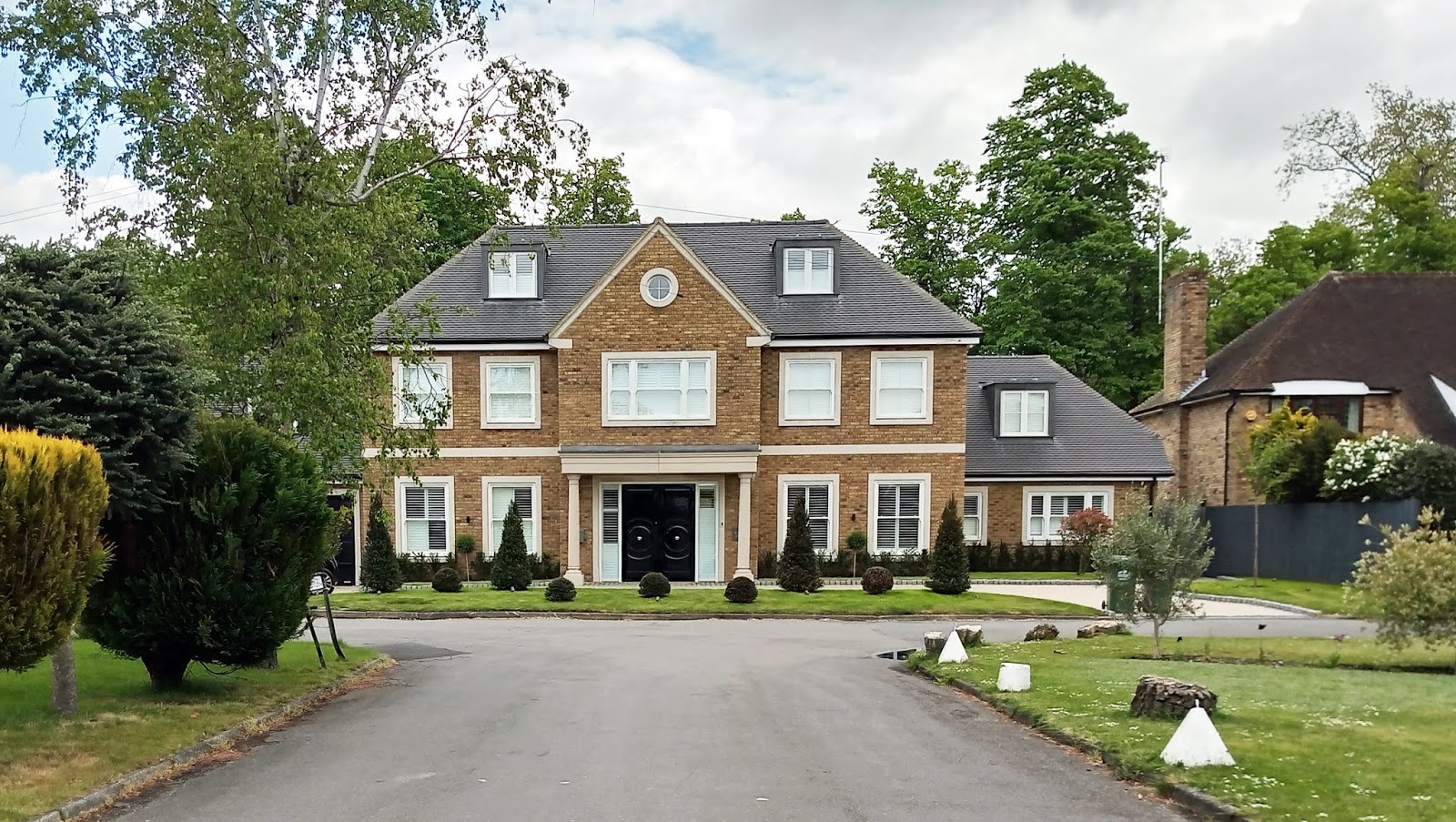
During these behind-the-scenes urban strolls we've discovered whole neighbourhoods we never knew existed, including one we've nicknamed 'Beverly Hills' due to the gorgeous huge houses and manicured gardens. I'm sure the inhabitants peer nervously out at us, seeing us as infected zombies in the middle of their lovely road, but we don't care; their isolation is likely to be splendid and include indoor swimming pools, gymnasiums and home theatres. I'm guessing they never leave the house and have all their wants and needs delivered.


Splendid isolation
But they’re missing out. Perhaps they have no idea there’s a lake not far from the London Irish Rugby Club, (the what??) or that there are broad walkways and cycle trails behind the houses, that the main park is actually still open, or that the scandal of the neighbourhood is that there's something F-ing missing from The Three ishes pub. If so they're welcome to their splendid isolation. 

Stopping briefly at the local shop on the way home we bought a bottle of Prosecco. May as well celebrate that - for us at least - the enforced pandemic isolation has led to discovery, and we now know where we live.