Showing posts with label Covid-19. Show all posts

Thursday, 4 February 2021

The Success of Self-Publishing

 Mike Bodnar looks at what opportunities the Covid pandemic has created for aspiring authors...

The impacts of Covid-19 on the mainstream book market are many, with closed bookshops, cancelled book launches and publishers' strategies in disarray. However, none of this seems to have stopped writers. If anything it's given them a new lease on life.

With more time stuck at home due to the pandemic, an increasing number of people are using the opportunity to write that novel, memoir or history book, and submit it in the hope of publication, fame and fortune. You've probably got an idea for a best-selling book tucked away in the back of your mind somewhere too, haven't you? Go on, you know you have.

However, all this time for creativity has ironically increased the workload of publishers and literary agents, even if their sector is in chaos. In a recent Guardian article, one publisher said that their normal workload of four or five manuscripts a day had increased since Covid to as many as 16 a day, while a literary agent complained that her quotidian in-tray now included as many as 27 manuscripts. Yes, you read that correctly: per day!

So competition for publishers' and agents' attention is intense, but you can bypass mainstream publishing altogether by self-publishing, which an increasing number of indie authors are doing – and not necessarily due to a fear of rejection.

Self-published books are finally breaking through the decades-old stigma they've suffered, namely that if it's self-published then by definition it's inferior. (And yes, it has to be said that some self-published books are sadly wanting, if not dire.) On the upside, self-publishing has become the method of choice for many successful writers because it generates a bigger share of sales revenue, while offering more control over the work.

Out of this world success

Waving the flag for independence are fêted titles such asThe Martian, Fifty Shades of Grey, Still Alice, and The Shack – all successful self-published works. But what 'success' looks like is important, and not always to do with how many copies an author sells or how rich and famous they become, as we'll see.

Then there are self-publishing companies, providing everything from proofreading and editing through to cover design, printing, marketing and sales management. You choose how much of a package you want, or can afford. The main difference between these companies and the big established publishers is that you pay them to publish your work, not the other way round.

Self-publishing options today are many, largely thanks to the internet and digital publishing opportunities; on-demand printing, eBooks, and audio books can be achieved easily, with no publisher involved and with potentially much greater profits than traditional publishing.

But before you start you need to ask, 'How will I define success?' In the examples of sell-out self-published books above, success is in sales numbers, rave reviews, publishing contracts and film deals. But success can be a lot more modest and diverse than that.

For example, let's say you wish to write your family history. Your 'market' is likely

Rave reviews...
 your immediate and extended family. So, they get to own a professionally-published record of the family chronicle, while you have the satisfaction of being the originator of the work. 

There's no financial reward and no film deal, but your market – small and intimate as it is – will be delighted with what you've created (and they'll give you all the rave reviews you want).

Or you might write a travel memoir, based on your adventures riding a motorbike halfway round the world. Here you want to entertain and inspire others, so your target market is the armchair traveller and would-be adventurer. Success therefore might be readers saying they enjoyed your book so much that they're now planning their own adventure.

Avoid clichés like the plague
Then of course there's the novel, that edge-of-the-seat thriller, sci-fi drama or fantasy battle between the forces of good and evil etc. and so on. Self-publishing allows you to indulge in all the clichés that mainstream publishers would reject out of hand. Just be aware that your target market might do the same! 

Success here could be that despite all the science-fiction that's been written in the last 200 years, you come up with something unique that grabs the imagination of the public and nets you sales in the millions. Or maybe you'll just win an award of some sort. Clear space on the mantelpiece now.

But success could also simply be the extremely practical result that your publishing and promotional costs have been covered by sales, to the point where the book doesn't owe you anything. Any subsequent sales are a bonus, (maybe enabling you to create an audio book version!).

This, as a matter of interest, is the situation I find myself in; I sold all 500 copies of my self-published travel book Against The Current (a modest but practical number to print) and although now out of print, the eBook version is still selling, plus I've made enough from sales to not only cover the costs of publishing but also to fund the audio book version (which so far has sold around 200 copies and is still going). I call that success, even though I'm still waiting for someone to buy the film rights off me.

Sold out, sorry...
So success in self-publishing is what you make it, and not just about rave reviews, getting on a best-seller list, or striking a movie deal.

If you've been thinking of using lockdown to finally turn that book idea into reality, go for it. But decide upfront what your success is going to look like. That way you won't be disappointed.

Now, get on that keyboard!


Friday, 23 October 2020

The Horrors of Halloween

This year Halloween falls on a Saturday, which means the real horrors of Halloween are even more frightening...

Image: © Mike Bodnar


Let me get one thing clear: I've always disliked Halloween. Not because I'm a curmudgeonly old bloke who loathes the concept of little children knocking on my door (I am), or because the whole thing has been commercialised beyond belief (it has), but because Halloween is just an excuse for pretend horror, and grisly ghoulish get-ups that have little to do with the Celtic origins of the festival. 

It has become an annual event in the same vein (see what I did there?) as Black Friday sales, Boxing Day sales and Amazon Prime Day. The sound of Halloween is not a blood-curdling scream or the howl of a werewolf - it is the ring of cash registers. 

Last year, research showed that Americans planned to spend US$8.8 billion on Halloween-related products and activities. Ka-ching! 

But the other sound of Halloween is the mournful wailing of ambulance sirens.

Eight billion US dollars. No wonder they're grinning. Image: Mike Bodnar
That's because Halloween activities have become synonymous with horror-filled statistics, with real-life incidents involving genuine blood, and genuine fear. And - sadly - actual death. And this year, with a plague on the loose, it has the potential to spread DREAD AND FEAR as never before (cue the Vincent Price laughing-track from Thriller).

No but seriously. Each year around Halloween the number of casualties in hospital departments rises - here in the UK, in the United States, and likely in other countries where All-Hallows Eve is 'celebrated'. 

Fireworks add to the risk in the UK/ Image: Mike Bodnar
Hand injuries sustained while carving pumpkins into grimacing toothy lanterns are common, while eye injuries caused either by chemical spillages from broken glow sticks or inappropriate use of ghoulish contact lenses all see medical centres busier than usual.

In Britain things are not helped by the fact that Halloween occurs less than a week before Guy Fawkes - bonfire night - so there's also an increase in firework-related burns and injuries.

In New Zealand the government's Accident Compensation Corporation - which pays wholly or partly for accidents (and subsequent rehabilitation) sustained within NZ - last year researched through six years' worth of Halloweens and found 136 related injuries. 

Not much compared with some other countries perhaps, but then the population is only around five million. The claims showed that they included the following words: 


    Always cut pumpkins away from you!
    Image: Supplied


  • trick or treat
  • prank
  • creep
  • pumpkin / carving
  • dress up / costume
  • lantern
  • lollies / candies
  • casket
  • cemetery
  • Halloween
  • ghost / ghoul
  • scare / fright
  • haunted
  • werewolf.
The most frequent injury type was ‘soft tissue’ (pumpkin carvers, I'm lookin' at you) but personally I'd just like to know who the 'creep' was.

Disturbingly - and this comes from the US but likely applies in other places - more children are injured or killed by cars on Halloween, due to trick-or-treating out after dark. Analysts say it's not always the fault of the drivers either, as Halloween masks can inhibit a child's vision when crossing roads, so they might not see a vehicle approaching. 

It's even worse when Halloween falls on a Saturday because there's a higher number of alcohol-affected drivers on the roads. 

SATURDAY HORRORS

Research in the US suggests that it's not just drunk drivers who are to blame; in 2015 - the last time the Day of Dread fell on a Saturday - Dr Sarah Denny, a physician at Nationwide Children's Hospital in Ohio, noted that when Halloween falls on a Saturday parents at home relaxing after their working week can consume more alcohol, and have a correspondingly more relaxed attitude to their children's activities. Which means that an extra number of kids might be unsupervised, allowed to stay out later, roam further and, well, you know the dangers.

She also notes that the kids themselves are less vigilant: 'A lot of it is the excitement of what's going on and people are less careful."

Stay safe! Image: Mike Bodnar
The bad news is that this year Halloween falls on a Saturday again. 

The good news - ironically given that October 31 is a day of zombies and fear - is that with Covid-19 present in society (and a UK government edict that outdoor Halloween activities are to be banned in lockdown areas) there will be fewer children trick-or-treating, and depending on local lockdown restrictions, maybe fewer drivers on the roads too. 

Despite the fact that we have the genuine horror of an actual pandemic to cope with, virologist Dr Chris Smith from the University of Cambridge is optimistic, and says that it is still possible to enjoy Halloween safely providing we take certain measures.

In a recent BBC report he said, 'Because it's Halloween I'd say people are quite likely to be wearing a mask anyway so if they can make a face covering work it's [sic] way into their costume then even better.' 

Wrapped sweets: recommended. Image: Mike Bodnar
Dr Smith advised that trick-or-treaters should avoid visiting elderly or vulnerable neighbours and should consider prearranging visits with householders who are comfortable with them knocking on their doors. 

The virologist warned that the nature of the tricks should also be thought through, as any that involve entering a property or close contact could increase the risk of Covid transmission. 

He had further advice regarding treats, saying that handing out unwrapped sweets ('candy' for our American cousins) or offering them in a bowl where multiple children can delve their hands in isn't recommended, and that wrapped sweets are preferable. Better still, he advises (grumpy) people like me just to hang a bag of wrapped sweets outside so the little blighters can help themselves (grumpy is my inclusion, not his).

Personally, because I'm curmudgeonly and old, I'd be delighted if the government just banned Halloween outdoor activities nationwide this year so I won't have to suffer kids knocking on our door trick-or-treating. But on a more practical level I will be happy to see a drop in accident statistics as a result of more people staying home, enabling medical centre staff to concentrate on a more normal workload.

That doesn't mean I'll be totally safe of course - the real of horror of this Halloween is that October 31 is my wife's birthday, and I haven't got her anything yet!


Further:

NHS advice for a safer Halloween and Bonfire Night

The Metro guide to this year's Halloween

If you think this article is worth sharing please do, plus I always welcome comments :-)


Monday, 12 October 2020

Bordering on Ridiculous

Entering the UK from a dangerous Covid country has never been easier...


A black helicopter is circling our house as I write this. I suspect the pilot and observer are checking to make sure that our car is parked outside and that we haven't driven on an eyesight test to Barnard Castle. Because, you see, we are in quarantine.

Under surveillance...

Not because we have Covid or anything; our self-imposed lockdown is due to having recently returned from France, which is one of the places on 'the list' of Covid-risky destinations, and Liz and I are adhering to the strict confinement requirements for travellers returning from such plague-ridden countries.

I suppose I need to justify why we went there in the first place, as you might see it as irresponsible in these worrying times. In short, my father-in-law Reg, who lives in France, was turning 90, and we wanted to go and celebrate this significant milestone, or kilometrestone as they call them over there. And to do so we were quite prepared to quarantine ourselves for the mandatory fortnight on return.

So far it's not been a hardship as we'd stocked the pantry before we left and brought a whole lot of produce (and wine, of course) back with us, so we will cope for the two weeks' isolation, except perhaps for asking neighbours if they wouldn't mind grabbing us a broccoli and cauliflower next time they go shopping.

While we might sound thoroughly organised, the same cannot be said for the UK government when it comes to promoting or enforcing the need for prudence (as the French would call it, pronouncing it 'proo-darnce') on returning to this land of hope and glory. (You can't say those words out loud any more. Ed.) 

Cases of wine, not Covid
Because, as we discovered, nobody official seemed to give a damn that we might be bringing back two cases of Covid along with our eight cases of wine.

The only bit of officialdom we had to cope with was filling in an online government form - which we were obliged to do no earlier than 48 hours before returning to the UK border - which stipulated our personal details: names, address, contact numbers, so forth, and our travel plans. This then had to be downloaded to our phones, which we did, because - as we were sternly warned - we could face lengthy delays at the border if we didn't have this documentation. And it would be checked by border officials. Ooh, scary.

The form, once downloaded, included a barcode, which we assumed would be scanned upon our return and that we'd be given a lecture to drive straight to our place of quarantine and not stop anywhere along the way, do not go to a service station, or pass Go and do not collect £200.

'Border Force officers will scan the QR code...'

So what happened? Nothing. Nada. Zip. In the whole week-long sojourn, including travelling Folkestone-Calais-Folkestone on the Euroshuttle, there was not a single sign, billboard, announcement or personal reminder from immigration officials or anyone else that we must quarantine ourselves on our return. In fact, so much for needing to download the all-important form to our phones - when we reached Folkestone we drove off the train and straight onto the M20. Not a single person anywhere to scan our barcodes, not a single announcement even while we were on the train in the Eurotunnel, which would have been the ideal time to reinforce the measures as we were all stuck on board for just over half an hour and were the perfect captive audience.

Sacre bleu! Young people wearing masks!
The French themselves - at least the ones we came into contact with in the Rhône-Alpes region in the south-east - took their Covid measures very seriously. Masks were obligatoire everywhere, not just in shops but on the streets as well, and everyone wore them, even - gosh - young people. 

Supermarket checkout staff were behind screens, there was plenty of hand sanitizer available, social distancing was observed, and everyone seemed to accept the measures willingly. Since we did likewise we think it's very unlikely that we've brought Covid back with us, and thus far - almost a week after returning - we're showing no symptoms. A few hangovers maybe, but we can blame the wine for that.

We are confined to home for another nine days yet. We have heard anecdotally that one person who returned from overseas was phoned up by the police to ask if she was at home. When she told them she was they asked her to go to her front window and wave to them as they were parked outside. Sneaky, but effective. We've been waiting for a similar phone call asking us to go and wave to two of Surrey's finest since getting back but so far nothing. 

Except for the helicopter circling the house of course.

Postscript, 24 October:

Well, we reached the end of our two-week quarantine on Wednesday 21 October without any obvious Covid symptoms but also a complete absence of any authority checking that we stayed home. Boris owes us one.

Friday, 18 September 2020

Ignorance, Bliss, No News, Good News

To quote CJ, the boss of Sunshine Desserts in The Fall and Rise of Reginald Perrin: 

Cognitive Distortion.
Image: © Mike Bodnar

'I didn't get where I am today by using clichés,Reggie. I avoid clichés like the plague'.

And while I agree with him about the use of clichés, here are two that have recently reared up and become an important part of my life: No news is good news, and ignorance is bliss. Tell you why...

A few weeks back I started feeling depressed and even slightly angry. It wasn't a one-off one-day thing - I was feeling this way from morning onwards throughout the rest of the day, every day. My usual second coffee didn't help, nor did nice weather. Alcohol might as well have been water, and going for a walk just made me introspective rather than appreciative of my surroundings.

I've had depression before and been on medication for it, quite a long time ago now, but I remember clearly how it felt. The symptoms will vary from person to person, but for me it was a feeling of hopelessness and a sense of 'why bother? And, 'why me?' A real sense of, well, depression and - importantly - helplessness. That was the worst thing, helplessness.

So it worried me to recognise these symptoms again a few weeks ago, and concerned me also that in general I had little or nothing to be depressed about. Lockdown had been relatively easy and not too much of a chore, I don't mind wearing a face mask (most people would be pleased that I am!), and although I missed travelling and we had to rethink journeys and having visitors, it didn't worry me too much. So what was it?

In short, the news. I realised I had got into a daily rut (which is the word 'routine' with some letters missing) where the first thing I would do on waking each morning was go online to read the Guardian and the BBC News, followed by some social media. Later in the day I'd watch the evening news, just to see what had changed or happened since the morning.

And it dawned on me that what was getting me down was that the news in general, week after week - in fact for months if not years - has not been good. The Brexit debacle, Trump, the Amazon rainforest disappearing, climate change,

A dangerous virus
species extinctions, knife crime, police shootings of black people and the resultant BLM protests, Russian conspiracy theories, the Royals divided, a violent reaction to statues connected to slavery or racism, and of course the virus, with the attendant shambolic government responses.

Yes that's a personal selection and yes there has been some good news (cue Captain Sir Tom), but I propose it has been vastly outweighed by the bad. And it vastly imbalanced my mental wellbeing. Turns out I am not alone, and that overexposure to news and the adverse impacts it can have on a person's mental well-being is a thing.

The website verywellmind.com has an article about the negative impact of bad news and Covid-19 in particular. It quotes psychologist, Logan Jones, PsyD, who says, 'Unfortunately, a lot of the news we consume today isn’t so much reporting as it is a way of keeping people addicted to the news cycle'.

He adds that sensational headlines attract more attention, so media outlets frequently focus on disaster reporting at the expense of positive news.

Boris Johnson

The same article quotes Annie Miller, who has a string of letters after her name stolen from the Polish alphabet: MSW, LCSW-C, LICSW. She says, 'It can be damaging to constantly be reading the news because constant exposure to negative information can impact our brain'. She adds that our brain then activates the 'fight or flight' response, and the systems in our body react accordingly.

And it turns out there's a chemical equation to all this; watching or being exposed to a lot of negative news can release stress hormones such as cortisol and adrenaline. The likelihood of this happening increases during a crisis (e.g. every time Trump opens his mouth, Covid-19 in particular, Boris Johnson failing to get to grips with the virus, and the complete omnishambles of mixed messaging from government in general) to the extent that we can develop physical symptoms. Some of the most common are: fatigue, anxiety, trouble sleeping, and - guess what? - depression.

Time magazine, in a report in May this year, quoted Graham Davey, Professor Emeritus of

Prof. Davey. Image: Psychology Today


Psychology at Sussex University and editor-in-chief of the 
Journal of Experimental Psychopathology as saying, 'The way that news is presented and the way that we access news has changed significantly over the last 15 to 20 years', adding that: “These changes have often been detrimental to general mental health'.

The changes he refers to are that news reports are 'increasingly visual and shocking', but also of course it's to do with how we get our news; mainstream media, social media, even celebrity and influencer gossip - all bombard us on an all-too-frequent basis. Never has there been such omnipresent and widespread 'news', opinion or comment; it's available 24/7.

So it's not just how I was consuming the news, it was the news media itself and the way it was being presented. Turns out I'm a victim. Okay, poor Mike you say, why can't you just look the other way and shrug off the negativity? 

Loretta Breuning.
Image: psychologytoday.com
Because, says Loretta Breuning, a former professor of management at California State University who unknowingly rushes to my defence, the human brain is actually attracted to troubling information since 'we are programmed to detect threats rather than overlook them'. In the Time article she says, 'This can make it hard for us to ignore the negatives and seek out the positives around us... our brain is predisposed to go negative, and the news we consume reflects this'.

Whoa! So now we're in a situation where our brains are predisposed to 'go negative' while at the same time we are exposed to an increasing amount of negative news coverage presented in sensational and don't-look-away styles, and our bodies react chemically resulting in actual imbalance of our physical and mental states. Vicious circle. Fact! Nobody knows more about vicious circles than me.

But all is not lost; there is an answer, there is hope. The solution, the experts say - as with alcohol, fast foods, sugar and other things that can be bad for you in

extreme doses - is to practise moderation in your news consumption. Supporting this, the World Health Organization (WHO) recommends for example searching news about Covid-19 largely so that 'you can take practical steps to prepare your plans and protect yourself and your loved ones'. Once you have that information, WHO says, it’s time to turn the news off.

The same approach applies therefore to all negative impactful news, and as we all know we've got no shortage of it. But I arrived at these answers myself before I read any of this, and I'm here to share it with you. It's fine, you're welcome.

About a month ago I changed my routine, and for weeks now I have not read any news, nor watched TV news bulletins. Stories that try and attract my attention on Twitter or Instagram go ignored, unless they're of particular interest to me. I will click on any news of archaeological finds, space travel, astronomy, resurgence of wildlife, or amazing photography from National Geographic. (Note to friends: photos on Facebook of food, pets or grandchildren still don't do it for me so don't even try). My wife Liz lets me know if there's anything really important that I need to know about, and that's an acceptable answer too - rely on a trusted companion for your news.


Do I feel any better? You bet I do; I have more energy, I am more relaxed, certainly more optimistic, and all my depression symptoms have dissipated. I feel like a million dollars, and no medication was required, so I've eased pressure on the NHS at the same time.

I know you're going to say, 'That's all very well, but it doesn't stop bad news happening, and you could be missing out on important events'. True, bad news will always happen, as will major events, but nothing I can do will change or in any way influence them if they've happened, certainly not just by knowing about them. So I am happy (literally) to be ignorant, and I now realise that ignorance really can be bliss. I know Covid-19 is still rearing its ugly head, but then, I avoid clichés like the plague. 


Friday, 1 May 2020

Covert-19: Secrets of the Neighbourhood

During lockdown The Tightly-Furled Umbrella has been going for daily walks and has discovered a whole new world...

For the past two years our neighbourhood has been hiding secrets. It has quietly kept various parts of itself hidden, covert, invisible. We have only just discovered this and we're really really annoyed, mostly because it's our fault.

You see, thanks to the pandemic Liz and I have been forced to explore our 'hood in some detail. Not just because our daily government-approved exercise regime gets us out of the house, but because we're now boldly going to places we've not been before, splitting infinitives along the way. 
Behind the houses, awaiting discovery...

We've taken to walking roads, alleys, public footpaths and alongside fields and hedgerows that only now have suddenly appeared. They've always been there of course, just not within our usual orbit. 

Eschewing maps or navigation devices, these days we just go wherever the fancy takes us, and it's woken the Magellan, Scott, and the Hillary in us. Or in Liz's case, the Earhart, Tereshkova and Eberhardt. We've drawn the line at donning pith helmets and carrying rifles, but the spirit of adventure and exploration is with us on every walk, even if it does take in the local grocery store on the way back.

Our local discoveries are even more revealing because we're exploring on foot instead of driving in the car; being perambulatory we can go down the narrow confines of alleyways or along walking and cycle paths where vehicles aren't allowed, and that's a good thing. Parks and other recreational spaces (where they aren't closed due to the virus) are very much on our agenda too, but it's the discovery of previously unknown trails that delight the most.

Last weekend our explorations led us down a dead-end road from where we escaped through a hedge and onto a lane leading to the headquarters of the London Irish Rugby Club, a significant structure with at least five adjacent rugby pitches. Who knew? Like most other sports grounds however, the club itself is closed for the duration, but it turns out the club's vehicles are being used by volunteers to deliver food to those who need it most during the pandemic. Thumbs up to them. 
Single file please...

Luckily - even though my chances of making a forward pass at Liz were thwarted - the public footpaths alongside and around were still open for walkers, runners and cyclists.

During these times of social distancing, we've all had to become attentive and inventive in how we use pathways, especially the narrow ones bordered by hedges. Meeting a family of three or four walking a dog coming towards you means someone has to 'give way' or take action to maintain two-metre/six feet distancing, which isn't always easy. Some of our local alleyways are so narrow there's only room for one person at a time, or a group snaking through in single file. 

On the footpaths around the rugby club we found ourselves backing into hedgerows more than once to make way for others, and became a little too familiar with nettles and brambles. On the plus side, one of these leafy diversions revealed a previously unknown lake on the other side, so that was a bonus.
Plenty of plots available, apparently

Circumnavigating the rugby fields without too many scratches we finally came to the local cemetery, which was open for walking through. 'Still plenty of plots available,' noted my wife. I wasn't sure if this was a genuine reference to there being plenty of spaces or whether she was hinting at my advancing years and my 'vulnerable' status. I made sure to put a spring in my step and walked confidently on. Healthily, confidently on. Virtually skipping over the headstones. 

A bit further on we discovered that the name of one of the local pubs has changed - it's now called The Three ishes. The landlady is probably wondering where the F one of her letters has gone. If it was stolen I hope they find the culprit as it's obviously a capital offence. (That's enough - Ed.)
What the F?

I said to Liz, 'When it finally reopens I look forward to going in for a rothy pint of beer and a plate of ish and chips'. (What did I just say? - Ed.)

Meeting others walking on the pavements (sidewalks for our American cousins) it has now become normal to practise the 'social sidestep', where one or the other of us takes a slight detour to maintain a safe distance. For many - including us - this sometimes involves stepping onto the road, and although the reduced overall traffic volumes have almost certainly resulted in lower vehicle accident rates, I do wonder whether pedestrian accident statistics have risen. It would be the supreme irony that you step onto the road to ensure you don't catch the virus only to be run over by a delivery van. Still, as Liz pointed out, plenty of plots available in the cemetery.


That said, the traffic volumes, especially in the backstreets, are now so low as to be almost non-existent, and Liz and I are often able to walk in the middle of the road in perfect safety. It means that those who use the sidewalks are a safe distance from us and don't have to weave or veer, although we do have to keep a keen ear for any vehicle approaching us from behind. So far it's only been the mail van. (Ooh, imagine that: if you were killed by a mail van would you then be subject to a 'post'-mortem?) (That's it, you're fired - Ed.)

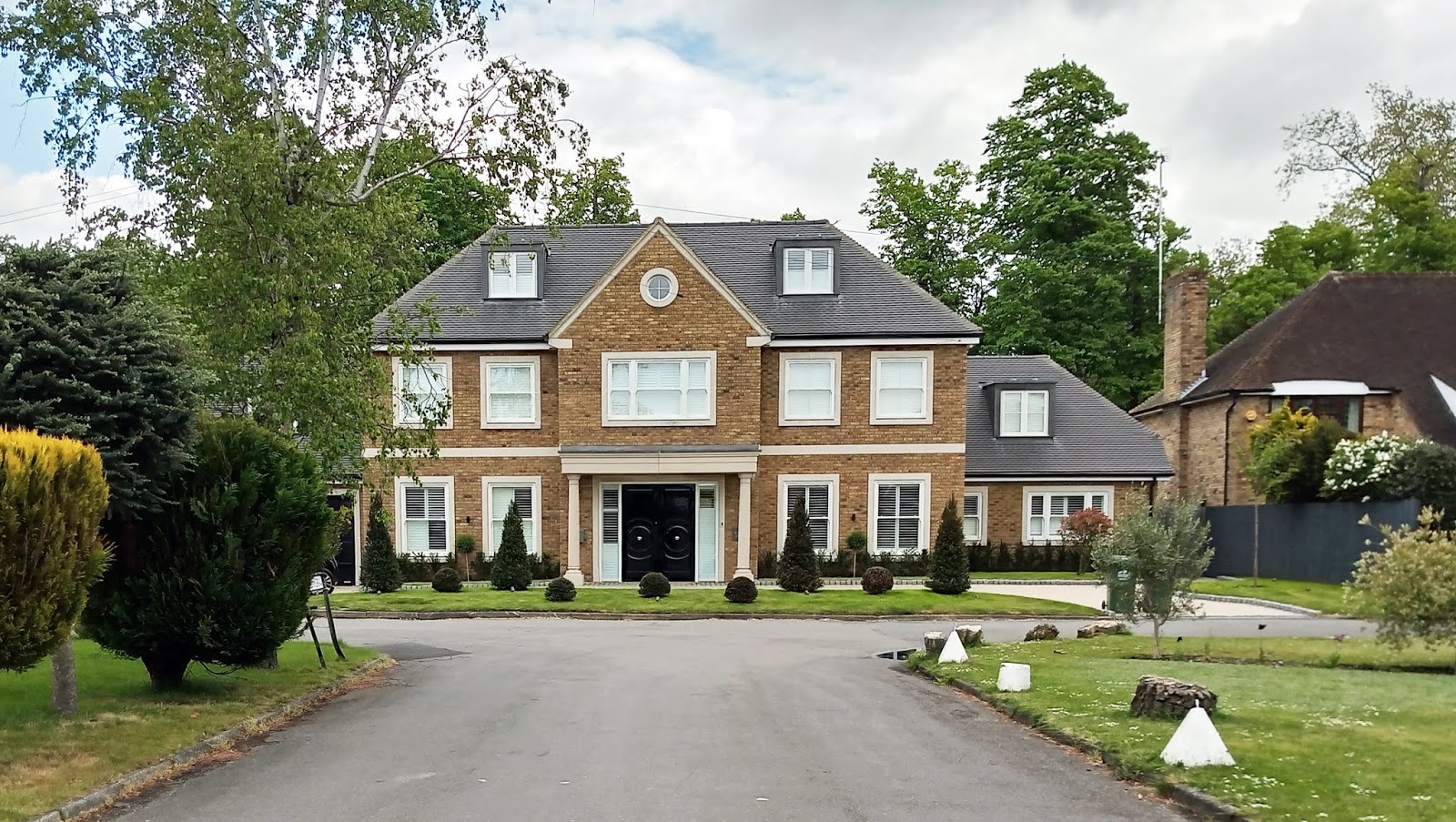
During these behind-the-scenes urban strolls we've discovered whole neighbourhoods we never knew existed, including one we've nicknamed 'Beverly Hills' due to the gorgeous huge houses and manicured gardens. I'm sure the inhabitants peer nervously out at us, seeing us as infected zombies in the middle of their lovely road, but we don't care; their isolation is likely to be splendid and include indoor swimming pools, gymnasiums and home theatres. I'm guessing they never leave the house and have all their wants and needs delivered.


Splendid isolation
But they’re missing out. Perhaps they have no idea there’s a lake not far from the London Irish Rugby Club, (the what??) or that there are broad walkways and cycle trails behind the houses, that the main park is actually still open, or that the scandal of the neighbourhood is that there's something F-ing missing from The Three ishes pub. If so they're welcome to their splendid isolation. 

Stopping briefly at the local shop on the way home we bought a bottle of Prosecco. May as well celebrate that - for us at least - the enforced pandemic isolation has led to discovery, and we now know where we live.