Showing posts with label lockdown. Show all posts

Thursday, 4 February 2021

The Success of Self-Publishing

 Mike Bodnar looks at what opportunities the Covid pandemic has created for aspiring authors...

The impacts of Covid-19 on the mainstream book market are many, with closed bookshops, cancelled book launches and publishers' strategies in disarray. However, none of this seems to have stopped writers. If anything it's given them a new lease on life.

With more time stuck at home due to the pandemic, an increasing number of people are using the opportunity to write that novel, memoir or history book, and submit it in the hope of publication, fame and fortune. You've probably got an idea for a best-selling book tucked away in the back of your mind somewhere too, haven't you? Go on, you know you have.

However, all this time for creativity has ironically increased the workload of publishers and literary agents, even if their sector is in chaos. In a recent Guardian article, one publisher said that their normal workload of four or five manuscripts a day had increased since Covid to as many as 16 a day, while a literary agent complained that her quotidian in-tray now included as many as 27 manuscripts. Yes, you read that correctly: per day!

So competition for publishers' and agents' attention is intense, but you can bypass mainstream publishing altogether by self-publishing, which an increasing number of indie authors are doing – and not necessarily due to a fear of rejection.

Self-published books are finally breaking through the decades-old stigma they've suffered, namely that if it's self-published then by definition it's inferior. (And yes, it has to be said that some self-published books are sadly wanting, if not dire.) On the upside, self-publishing has become the method of choice for many successful writers because it generates a bigger share of sales revenue, while offering more control over the work.

Out of this world success

Waving the flag for independence are fêted titles such asThe Martian, Fifty Shades of Grey, Still Alice, and The Shack – all successful self-published works. But what 'success' looks like is important, and not always to do with how many copies an author sells or how rich and famous they become, as we'll see.

Then there are self-publishing companies, providing everything from proofreading and editing through to cover design, printing, marketing and sales management. You choose how much of a package you want, or can afford. The main difference between these companies and the big established publishers is that you pay them to publish your work, not the other way round.

Self-publishing options today are many, largely thanks to the internet and digital publishing opportunities; on-demand printing, eBooks, and audio books can be achieved easily, with no publisher involved and with potentially much greater profits than traditional publishing.

But before you start you need to ask, 'How will I define success?' In the examples of sell-out self-published books above, success is in sales numbers, rave reviews, publishing contracts and film deals. But success can be a lot more modest and diverse than that.

For example, let's say you wish to write your family history. Your 'market' is likely

Rave reviews...
 your immediate and extended family. So, they get to own a professionally-published record of the family chronicle, while you have the satisfaction of being the originator of the work. 

There's no financial reward and no film deal, but your market – small and intimate as it is – will be delighted with what you've created (and they'll give you all the rave reviews you want).

Or you might write a travel memoir, based on your adventures riding a motorbike halfway round the world. Here you want to entertain and inspire others, so your target market is the armchair traveller and would-be adventurer. Success therefore might be readers saying they enjoyed your book so much that they're now planning their own adventure.

Avoid clichés like the plague
Then of course there's the novel, that edge-of-the-seat thriller, sci-fi drama or fantasy battle between the forces of good and evil etc. and so on. Self-publishing allows you to indulge in all the clichés that mainstream publishers would reject out of hand. Just be aware that your target market might do the same! 

Success here could be that despite all the science-fiction that's been written in the last 200 years, you come up with something unique that grabs the imagination of the public and nets you sales in the millions. Or maybe you'll just win an award of some sort. Clear space on the mantelpiece now.

But success could also simply be the extremely practical result that your publishing and promotional costs have been covered by sales, to the point where the book doesn't owe you anything. Any subsequent sales are a bonus, (maybe enabling you to create an audio book version!).

This, as a matter of interest, is the situation I find myself in; I sold all 500 copies of my self-published travel book Against The Current (a modest but practical number to print) and although now out of print, the eBook version is still selling, plus I've made enough from sales to not only cover the costs of publishing but also to fund the audio book version (which so far has sold around 200 copies and is still going). I call that success, even though I'm still waiting for someone to buy the film rights off me.

Sold out, sorry...
So success in self-publishing is what you make it, and not just about rave reviews, getting on a best-seller list, or striking a movie deal.

If you've been thinking of using lockdown to finally turn that book idea into reality, go for it. But decide upfront what your success is going to look like. That way you won't be disappointed.

Now, get on that keyboard!


Monday, 12 October 2020

Bordering on Ridiculous

Entering the UK from a dangerous Covid country has never been easier...


A black helicopter is circling our house as I write this. I suspect the pilot and observer are checking to make sure that our car is parked outside and that we haven't driven on an eyesight test to Barnard Castle. Because, you see, we are in quarantine.

Under surveillance...

Not because we have Covid or anything; our self-imposed lockdown is due to having recently returned from France, which is one of the places on 'the list' of Covid-risky destinations, and Liz and I are adhering to the strict confinement requirements for travellers returning from such plague-ridden countries.

I suppose I need to justify why we went there in the first place, as you might see it as irresponsible in these worrying times. In short, my father-in-law Reg, who lives in France, was turning 90, and we wanted to go and celebrate this significant milestone, or kilometrestone as they call them over there. And to do so we were quite prepared to quarantine ourselves for the mandatory fortnight on return.

So far it's not been a hardship as we'd stocked the pantry before we left and brought a whole lot of produce (and wine, of course) back with us, so we will cope for the two weeks' isolation, except perhaps for asking neighbours if they wouldn't mind grabbing us a broccoli and cauliflower next time they go shopping.

While we might sound thoroughly organised, the same cannot be said for the UK government when it comes to promoting or enforcing the need for prudence (as the French would call it, pronouncing it 'proo-darnce') on returning to this land of hope and glory. (You can't say those words out loud any more. Ed.) 

Cases of wine, not Covid
Because, as we discovered, nobody official seemed to give a damn that we might be bringing back two cases of Covid along with our eight cases of wine.

The only bit of officialdom we had to cope with was filling in an online government form - which we were obliged to do no earlier than 48 hours before returning to the UK border - which stipulated our personal details: names, address, contact numbers, so forth, and our travel plans. This then had to be downloaded to our phones, which we did, because - as we were sternly warned - we could face lengthy delays at the border if we didn't have this documentation. And it would be checked by border officials. Ooh, scary.

The form, once downloaded, included a barcode, which we assumed would be scanned upon our return and that we'd be given a lecture to drive straight to our place of quarantine and not stop anywhere along the way, do not go to a service station, or pass Go and do not collect £200.

'Border Force officers will scan the QR code...'

So what happened? Nothing. Nada. Zip. In the whole week-long sojourn, including travelling Folkestone-Calais-Folkestone on the Euroshuttle, there was not a single sign, billboard, announcement or personal reminder from immigration officials or anyone else that we must quarantine ourselves on our return. In fact, so much for needing to download the all-important form to our phones - when we reached Folkestone we drove off the train and straight onto the M20. Not a single person anywhere to scan our barcodes, not a single announcement even while we were on the train in the Eurotunnel, which would have been the ideal time to reinforce the measures as we were all stuck on board for just over half an hour and were the perfect captive audience.

Sacre bleu! Young people wearing masks!
The French themselves - at least the ones we came into contact with in the Rhône-Alpes region in the south-east - took their Covid measures very seriously. Masks were obligatoire everywhere, not just in shops but on the streets as well, and everyone wore them, even - gosh - young people. 

Supermarket checkout staff were behind screens, there was plenty of hand sanitizer available, social distancing was observed, and everyone seemed to accept the measures willingly. Since we did likewise we think it's very unlikely that we've brought Covid back with us, and thus far - almost a week after returning - we're showing no symptoms. A few hangovers maybe, but we can blame the wine for that.

We are confined to home for another nine days yet. We have heard anecdotally that one person who returned from overseas was phoned up by the police to ask if she was at home. When she told them she was they asked her to go to her front window and wave to them as they were parked outside. Sneaky, but effective. We've been waiting for a similar phone call asking us to go and wave to two of Surrey's finest since getting back but so far nothing. 

Except for the helicopter circling the house of course.

Postscript, 24 October:

Well, we reached the end of our two-week quarantine on Wednesday 21 October without any obvious Covid symptoms but also a complete absence of any authority checking that we stayed home. Boris owes us one.

Friday, 8 May 2020

The Road to a Better Future


The Tightly-Furled Umbrella takes a poke at our vehicle usage and wonders whether government intervention might not be a bad thing…


Picadilly Circus, with no performers
As the country has had plenty of time for thinking and general reflection on life’s values over the past few weeks, one of the things to come out of it is that a certain number of us plan to ‘do things differently’ in the future.

This could of course end up being no more binding than New Year resolutions – abandoned after a few weeks when we get tired of the effort – but one aspect that I'm really hoping will change is our use of motor vehicles. Make that 'overuse' of motor vehicles.

I would give anything to go into central London right now and experience the deserted streets with hardly any traffic and almost zero pollution. The peace and quiet would be novel too. But alas I'm not an essential worker (more ‘essentially lazy’ if anything) so I haven’t gone in, and it’s a bit far for me to justify as ‘exercise’.

Traffic cameras showing nearly empty roads on a weekday
But that annoyance apart, it would be wonderful to think that our cities’ streets might be a tad quieter and less congested post-pandemic due to a new realisation that, hey, maybe we don’t need to take the car out quite so often after all. Recent research indicates this could indeed be the case.
According to the UK government, data recently recorded at 275 automated sites show that journeys in vehicles are now around 35% to 45% of the usual level, and even that takes into account ‘creep’. (No, that's not the strange guy who drives past your place looking weirdly at your house – in this instance it means our vehicle usage has slowly crept back up since lockdown was introduced). The Automobile Association has reportedly said traffic volumes in Britain are now 'akin to those in the early 1970s' when they were just one-third of what they are today.
But this is obviously due to the government lockdown restrictions rather than any voluntary commitment on the part of vehicle owners to ‘go green’ or use their cars less for a better world. That said, another recent survey shows that many people are – post-pandemic regulations – expecting their use of buses and trains will drop and, importantly, 24% of those plan to work from home more.

Should the survey results translate into actual changes in behaviours, this could mean we’ll see much less traffic on the roads, drops in air pollution, fewer accidents, and less reliance as an economy on oil and petroleum products. The roads will become a bit safer for cyclists too.

So rather than wait for a voluntary change in behaviour could the government not instead legislate for fewer vehicles on the road? It’s been done before overseas, but did it work, and could it work here?

Flashback to New Zealand, 1979 - the country was facing an oil crisis where imports had become prohibitively costly, with OPEC raising the cost per barrel from US$12 to $19 during the first half of that year. Worse perhaps was the Iranian Revolution, which essentially shut down Iran’s oil industry - 5.7 million barrels per day were withdrawn from the world supply.

So, abandoning sheep shearing contests and leaving their pavlovas to go soggy the Kiwi government leapt into action and introduced the novel concept of ‘carless days’ on 30 July. They also reduced the open road speed limit from 62mph to 50mph.

The scheme – designed to reduce the nation’s demand for, and reliance on, oil imports - required those with private vehicles to nominate one day of the week on which they would not drive their vehicles. This was enforced with the introduction of heavy fines for those caught driving on their selected day. (There were exceptions for rural travel where public transport was almost non-existent, and ‘essential travel’ as in today’s lockdown) The carless days scheme applied only to petrol-powered vehicles and those weighing less than 4,400lbs. The restriction didn’t apply to motorbikes, scooters or mopeds.

NZ's carless day sticker selection. Image: Facebook
Less than a year after it began the scheme was scrapped, partly because it wasn’t popular but also because it didn’t reduce petrol consumption very much. (The reduced speed limit remained in place for a while longer) In principle carless days should have had an impact; private vehicle usage could have dropped by approximately one-seventh, but Kiwis are an inventive lot and many found ways of getting round the restrictions. Owning a second car was one of them (some bought a second vehicle just to avoid the scheme) while others purchased motorbikes.

A scathing newspaper column from the day also shows that an estimated 25 percent of Kiwis had successfully applied for legal exemptions to the scheme.

Obviously it wasn't working...
There’s a memory shared on Wikipedia of a bloke with a motorbike who could sometimes be found riding with his two flatmates as pillion passengers... plus a dog. A few clever Kiwis realised that if you applied for two different day stickers you could cover them in cling-film and easily attach or detach them from your windscreen according to whatever day of the week it wasn’t. Legally you were supposed to have your nominated sticker permanently attached.

But there are other stories – rather like those today from people feeling guilty about flouting the lockdown regulations – where motorists who drove their cars on their nominated carless day ended up feeling blameworthy and embarrassed. In short, there was a lack of engagement with and commitment to the scheme.

Accepted behaviour. 
Image: Wikimedia Commons
It’s a fact that if regulations of any sort are introduced some people will always find a way around them, but there are certain aspects of motoring where the culture has changed to match and support legislation, such as anti drink-driving, and the wearing of seat belts. So with the right approach to education, a groundswell of support in society, and enforcement and fines or points on your licence for flouting the law, behaviours can change. For carless days to be accepted today the concept would have to become the social norm.

So maybe post-pandemic would be a good time for the UK government to learn from New Zealand’s wobbly carless days scheme and introduce a better and more robust scheme here. Given that many people have realised during lockdown that they actually don’t need to drive their vehicles every day, this could be the perfect opportunity to permanently reduce the volume of traffic on our congested roads. The engagement and commitment might already be there.

Or is it a good time to buy shares in cling-film maybe?


Friday, 1 May 2020

Covert-19: Secrets of the Neighbourhood

During lockdown The Tightly-Furled Umbrella has been going for daily walks and has discovered a whole new world...

For the past two years our neighbourhood has been hiding secrets. It has quietly kept various parts of itself hidden, covert, invisible. We have only just discovered this and we're really really annoyed, mostly because it's our fault.

You see, thanks to the pandemic Liz and I have been forced to explore our 'hood in some detail. Not just because our daily government-approved exercise regime gets us out of the house, but because we're now boldly going to places we've not been before, splitting infinitives along the way. 
Behind the houses, awaiting discovery...

We've taken to walking roads, alleys, public footpaths and alongside fields and hedgerows that only now have suddenly appeared. They've always been there of course, just not within our usual orbit. 

Eschewing maps or navigation devices, these days we just go wherever the fancy takes us, and it's woken the Magellan, Scott, and the Hillary in us. Or in Liz's case, the Earhart, Tereshkova and Eberhardt. We've drawn the line at donning pith helmets and carrying rifles, but the spirit of adventure and exploration is with us on every walk, even if it does take in the local grocery store on the way back.

Our local discoveries are even more revealing because we're exploring on foot instead of driving in the car; being perambulatory we can go down the narrow confines of alleyways or along walking and cycle paths where vehicles aren't allowed, and that's a good thing. Parks and other recreational spaces (where they aren't closed due to the virus) are very much on our agenda too, but it's the discovery of previously unknown trails that delight the most.

Last weekend our explorations led us down a dead-end road from where we escaped through a hedge and onto a lane leading to the headquarters of the London Irish Rugby Club, a significant structure with at least five adjacent rugby pitches. Who knew? Like most other sports grounds however, the club itself is closed for the duration, but it turns out the club's vehicles are being used by volunteers to deliver food to those who need it most during the pandemic. Thumbs up to them. 
Single file please...

Luckily - even though my chances of making a forward pass at Liz were thwarted - the public footpaths alongside and around were still open for walkers, runners and cyclists.

During these times of social distancing, we've all had to become attentive and inventive in how we use pathways, especially the narrow ones bordered by hedges. Meeting a family of three or four walking a dog coming towards you means someone has to 'give way' or take action to maintain two-metre/six feet distancing, which isn't always easy. Some of our local alleyways are so narrow there's only room for one person at a time, or a group snaking through in single file. 

On the footpaths around the rugby club we found ourselves backing into hedgerows more than once to make way for others, and became a little too familiar with nettles and brambles. On the plus side, one of these leafy diversions revealed a previously unknown lake on the other side, so that was a bonus.
Plenty of plots available, apparently

Circumnavigating the rugby fields without too many scratches we finally came to the local cemetery, which was open for walking through. 'Still plenty of plots available,' noted my wife. I wasn't sure if this was a genuine reference to there being plenty of spaces or whether she was hinting at my advancing years and my 'vulnerable' status. I made sure to put a spring in my step and walked confidently on. Healthily, confidently on. Virtually skipping over the headstones. 

A bit further on we discovered that the name of one of the local pubs has changed - it's now called The Three ishes. The landlady is probably wondering where the F one of her letters has gone. If it was stolen I hope they find the culprit as it's obviously a capital offence. (That's enough - Ed.)
What the F?

I said to Liz, 'When it finally reopens I look forward to going in for a rothy pint of beer and a plate of ish and chips'. (What did I just say? - Ed.)

Meeting others walking on the pavements (sidewalks for our American cousins) it has now become normal to practise the 'social sidestep', where one or the other of us takes a slight detour to maintain a safe distance. For many - including us - this sometimes involves stepping onto the road, and although the reduced overall traffic volumes have almost certainly resulted in lower vehicle accident rates, I do wonder whether pedestrian accident statistics have risen. It would be the supreme irony that you step onto the road to ensure you don't catch the virus only to be run over by a delivery van. Still, as Liz pointed out, plenty of plots available in the cemetery.


That said, the traffic volumes, especially in the backstreets, are now so low as to be almost non-existent, and Liz and I are often able to walk in the middle of the road in perfect safety. It means that those who use the sidewalks are a safe distance from us and don't have to weave or veer, although we do have to keep a keen ear for any vehicle approaching us from behind. So far it's only been the mail van. (Ooh, imagine that: if you were killed by a mail van would you then be subject to a 'post'-mortem?) (That's it, you're fired - Ed.)

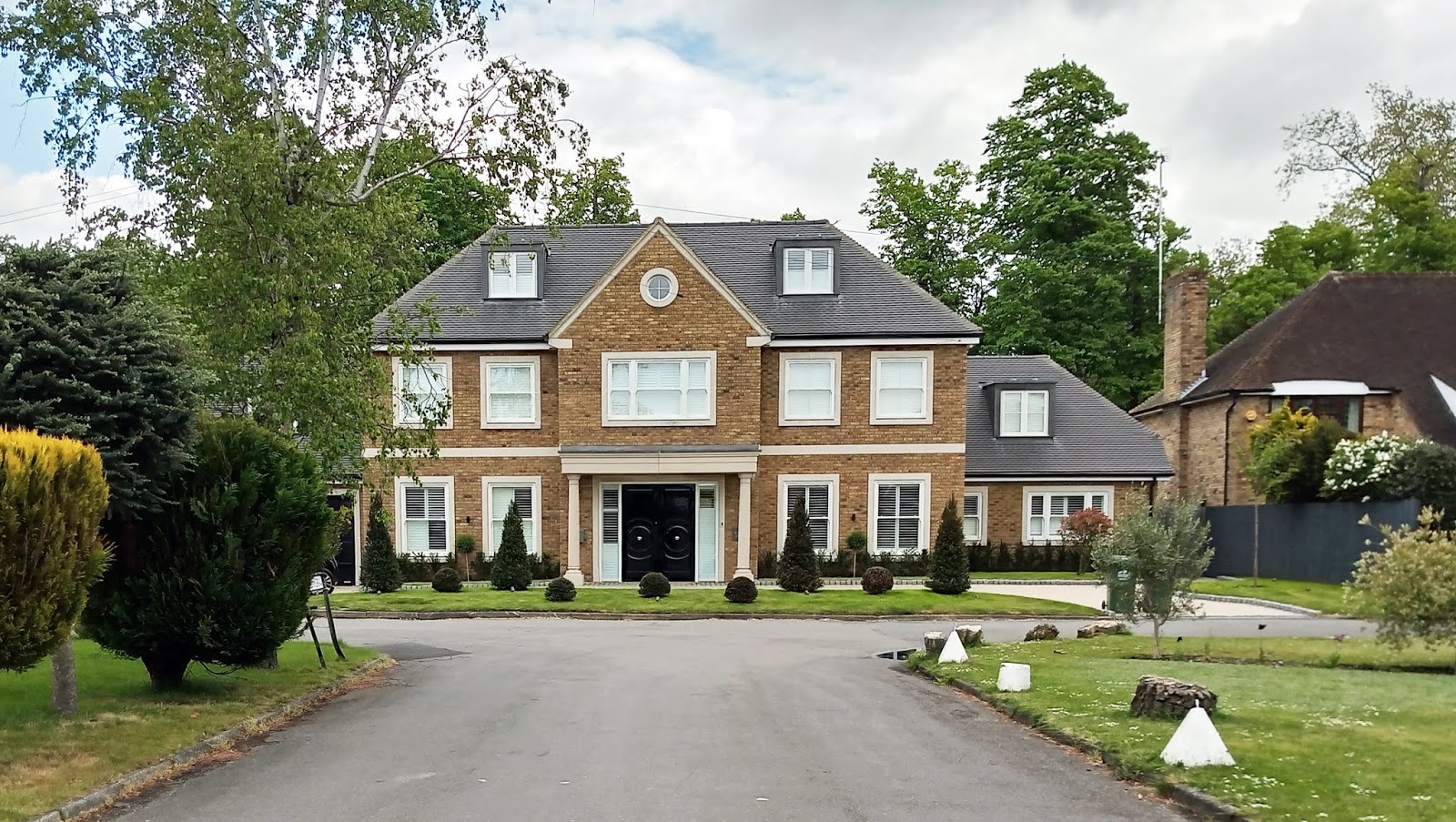
During these behind-the-scenes urban strolls we've discovered whole neighbourhoods we never knew existed, including one we've nicknamed 'Beverly Hills' due to the gorgeous huge houses and manicured gardens. I'm sure the inhabitants peer nervously out at us, seeing us as infected zombies in the middle of their lovely road, but we don't care; their isolation is likely to be splendid and include indoor swimming pools, gymnasiums and home theatres. I'm guessing they never leave the house and have all their wants and needs delivered.


Splendid isolation
But they’re missing out. Perhaps they have no idea there’s a lake not far from the London Irish Rugby Club, (the what??) or that there are broad walkways and cycle trails behind the houses, that the main park is actually still open, or that the scandal of the neighbourhood is that there's something F-ing missing from The Three ishes pub. If so they're welcome to their splendid isolation. 

Stopping briefly at the local shop on the way home we bought a bottle of Prosecco. May as well celebrate that - for us at least - the enforced pandemic isolation has led to discovery, and we now know where we live.


Thursday, 9 April 2020

Success in the Background


One of the things to come out of this whole virus lockdown thing is that everyone, even the media, has had to keep their distance. For television news this has meant interviewing politicians, academics and health professionals about the virus via the Internet, where viruses have a different meaning and (so far) can’t harm humans.

When the SARS outbreak occurred in 2003 such an option wasn’t available; Skype wasn’t first released until that year and the world (and the media) was yet to widely adopt video-calling technology. But today, even with the lockdown in place, the media can access anyone and everyone – experts and victims alike – at the press of a key. So far, so qwerty.

In normal circumstances experts and politicians would be invited into a studio for interviewing, or a reporter with camera operator would visit them at their workplace, but now the new norm is for the interviewees to talk to the journos via their own laptops. This means we as viewers are treated to sneak peeks of academics’ and other experts’ homes. Instead of a pristine studio backdrop, we get to glimpse the backgrounds of their everyday domesticity, and the scenery is varied to say the least, but a lot of what we see depends on how they’ve got their laptop set up.

Typically, many of those now working from home have their screen – and therefore its built-in camera – at a slight angle on their desk or worktable. This gives a very different image to that we’re used to of interviewees. Firstly, instead of being at eye level, now most of those interviewed appear to be looking down their noses at us, and, conversely we get an excellent view of their nostril hairs. More interestingly, behind them we can see some of their office/lounge/spare room ceiling and can admire their pelmets and light fittings.

But those whose screen tilt is more upright means we can take in more of the room – the furniture, drapes, mantelpiece, and – here’s what appears to be a common denominator among experts - their bookshelves. Many if not most of the specialists and academics interviewed during the pandemic have bookshelves in the background, often fitted, and filled choc-a-bloc with tomes which, infuriatingly, it’s usually impossible to read the titles of. I keep hoping to see a copy of ‘The Joy of Sex’ on a shelf behind a university vice-chancellor, or ‘The Andromeda Strain’ on the shelf of an NHS official.

But flippancy aside, the message I’m getting from this is that books and expertise, books and knowledge, books and authority, and perhaps most importantly, books and success go together. I’m not surprised by this – I’ve always held the belief that a household with books is a household of joy – but it’s nice to see it confirmed on screen via these people’s laptops, even if it is anecdotal.

It doesn’t automatically follow that success is wholly dependent on books filling your walls – the most successful kid in my fifth form went on to become a highly respected judge but he wouldn’t have a book in his house. He said he didn’t like ‘clutter’, and his house was bare; huge, but devoid of disorder. However, a sample of one is hardly conclusive evidence, and I put it to you ladies and gentlemen of the jury that his disdain of books reflected more a personal taste for clean lines and tidiness than anything else. But I could hardly rest my case on it.

Luckily, I don’t have to do extensive research to build an argument for books in the home – that’s already been done for me by many academics, including a trio of sociologists at the University of Nevada-Reno. In 2014 they published the findings of their research after analysing test scores from 42 different nations, which categorically showed a link between books in the home and academic success. The authors noted: ‘…the number of books in the family home exerts a strong influence on academic performance in ways consistent with the cognitive skill hypothesis, regardless of the nation's ideology, political history, or level of development.’

They acknowledged that some people theorise that the mere presence of books could skew gatekeepers’ markings and opinions towards the more positive end of the scale, but in their study they go on to demonstrate that books have a higher impact in less-advantaged home situations than those that could be described as elite.

The authors – Evans, Kelley and Sikora – note: ‘The gains are not equally great across the entire cultural hierarchy. They are larger at the bottom, far below elite level. Each additional book has a greater impact on the performance of someone who only has a small home library than it does on the performance of someone from a home overflowing with books.’

Many other studies have backed up these findings, and now – bizarrely thanks to a global pandemic – we are being treated to further evidence on our screens on a nightly basis. Seeing academics’ and experts’ bookshelves in the background is not only encouraging, it speaks volumes.


Monday, 23 March 2020

78 Days Later


Okay I’ll admit it: I’m a fan of the apocalyptic and post-apocalyptic movie genres. But there’s a certain irony in the fact that movie directors seeking to portray deserted cities – streets empty of humans and vehicles, silence where there was once noise, emptiness where bustle used to be – now have perfect film sets in nearly every city in the UK, except of course all shooting is on hold due to Covid-19.

No zombies, yet
Movies such as 28 Days Later and their like often have to shoot such scenes at 4.30 in the morning in summer when there’s enough daylight for filming but hardly any traffic or people. The window of opportunity is a narrow one. Alternatively they arrange for roads to be closed (in 28 Days Later they even organised traffic police to arrange a ‘rolling stop’ on the M1 in both directions so they could shoot a lone taxi driving north without having to overtake anything but its own shadow).

But it’s the main news bulletins rather than the big screens now showing deserted streets (or not, in the case of those defying health advice and still congregating), empty stations and trains, and closed pubs and restaurants, and disturbingly of course these scenes are real.

Usually standing-room only
You can be sure though there are already documentary makers out there, recording the empty roads for later use in the look-backs and investigations into how Coronavirus affected the population and how the government handled it. News footage too will be used for illustration, and there’s certainly no shortage of that - the media is having a field day. Come January 11 next year – one year exactly after the first Covid-19 death was recorded in China – our screens will be infected with Coronavirus documentaries.

So here’s a thing: why not make your own doco? This coming Friday it will be 78 days after that initial Covid-19 death, and although it’s an artifice, 78 Days Later seems as good a time as any to begin recording what you and your family is doing in these uncertain and unprecedented times. Think of it as a sort of war diary, only without the conflict (yet).

There have of course already been wartime memes – cartoons showing children asking
Image: Wikimedia Commons
their father ‘what he did in the virus’ and referring to his stockpile of loo paper etc. – but the analogy with World War 2 is a genuine one. Liz and I decided on Saturday to walk to our local butcher and show our support, only to find a queue of around 20 people outside. The only thing missing was the ration books, but hey, early days.

As you know, supermarkets and other retails stores are already rationing the amounts people can buy as a response to greedy hoarders stripping the shelves of everything. Social media is now awash with ideas for how to manage self-isolation, what to cook, how to make do and mend. Colleagues of Liz’s who luckily have some land available have just bought hens for their egg-laying.

Supermarket and local shop rationing
All of these are genuine stories, responses to adversity, but never has society had so many options at its fingertips for recording such a particular moment in history. Whether it’s a phone camera, tablet, a camcorder, a sports GoPro, or even a humble tape recorder (and let’s not forget the written word too), this unique time begs to be filmed, noted, captured and retold again and again. And in this technologically-advanced age, anyone and everyone can do it.

So don’t wait for the professionals to bring out their productions 378 days later. Be part of it yourself, now. Tell your story and share it. We are ordinary people living through extraordinary times. This is history in the making.

How to Conduct an Interview

It may be that rather than simply record your own version of events, you want to capture the feelings and experiences of those around you (maintaining appropriate social distancing of course). In this scenario you might find yourself doing an interview, either face to face or, more safely, over the phone or a video link.

Having formerly worked in broadcasting for many years I know there are many ways to conduct an interview but I’m going to touch on just two; one is a favourite of mine which I simply call The Conversation, and the second is a more established method. Either will give your recording that professional edge.

The Conversation Interview

In order to elicit the information and emotions of whoever you’re interviewing, you need, in principle, only one formal question, and that’s the first one. In fact it’s not so much a question as a request, and in this case it is: ‘Tell me about how the Coronavirus is affecting you and those around you…’

This is deliberately open-ended designed to allow the interviewee to answer as they see fit. What you need to do is actively listen to their answers so that you can follow up accordingly just as you would in a normal conversation. For example, if they say something like, ‘The virus has completely changed everything in my life’ and then they stop, you need to ask ‘How?’, and let them continue.

Also, there’s nothing wrong with expressing your own reactions to what your interviewee says. If for example they reveal something surprising, it’s perfectly fine to respond with ‘Really?’ or ‘Wow’, but use these sparingly. As an interviewer your job is to draw out the story rather than be part of it, unless you’re recording yourself in a memoir scenario.

Your keyword friends in the conversation interview are the journalist’s staple: who, where, why, what, when, and how. These form the basis of all news stories. They also form the basis for the more conventional interview…

The Conventional Interview

In this scenario you prepare a list of questions that you know you want specific answers to, and which ensure you cover the topic both broadly as well as in detail.

So, applying these in an interview situation means asking such things as:
  • Who among your family and friends were affected?
  • How did it affect them?
  • Where were they at the time?
  • Why did it have such a big impact?
  • What did you/they do?
  • When did you realise that this was really serious?
…and so on. Obviously you can also use the ‘Tell me about…’ lead.

But the main thing is that you still have to actively listen to the answers and follow up on them, especially where they take you by surprise. Don’t become a slave to the list of questions you prepared. Ultimately you represent the people who are watching or listening to your interview, so be aware of your own emotions and respond accordingly.

That's it in a nutshell. Here are a couple of tips too:

Top Tip 1: Avoid asking too many closed-ended questions such as, ‘Was that terrifying?’ because it begs just a short answer. If all they say is ‘Yes’, then you are duty-bound to follow it up with, ‘How?’, so it’s better to give them a bigger canvas to work with and use a question framed as, ‘Many people must have found the situation terrifying; how was it for you?’

Top Tip 2: Avoid grunting, saying ‘uh-huh’, and verbalising your agreement or encouragement as it can be really distracting for the listener or viewer, especially if it’s a video situation and you’re off-camera. If you need to encourage your interviewee, use facial signals and body language: nod your head in encouragement, smile as appropriate, raise your eyebrows, shake your head in disbelief - all of these are silent yet effective means of encouraging your subject.

Good luck, and don't forget to share your stories!

P.S. If you have any comments simply click on the Comments or No Comments link below. Also, if you enjoy these blogs please share! :-)